
Quick Answer
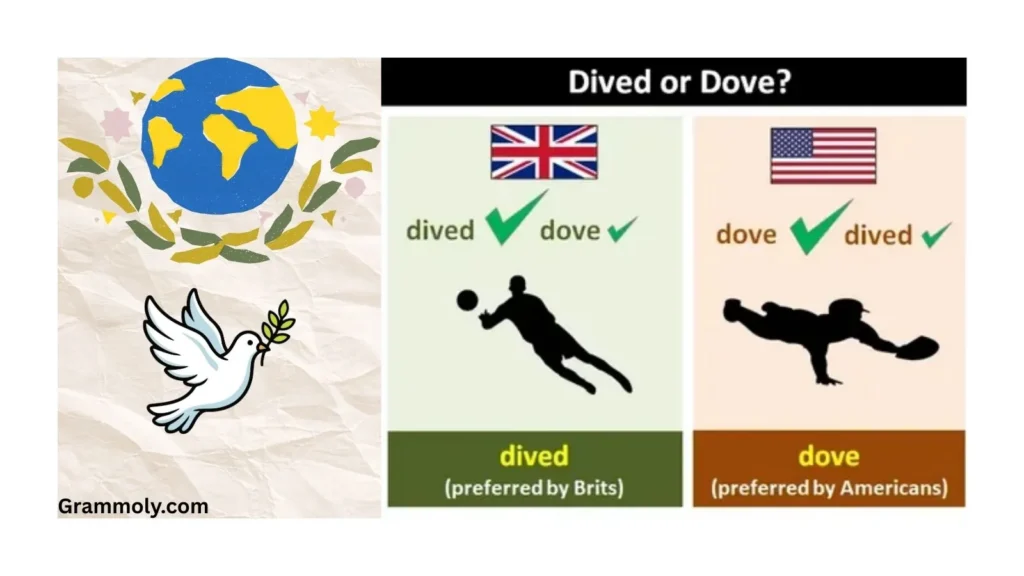
Many people ask “dive or dove” when writing about the past tense of dive. The short answer is that both forms are correct, but their usage depends on location and style. In American English, speakers commonly say “dove” as the past tense of the dive irregular verb, such as “He dove into the pool.”
|See also: Lint or lent
In British English, writers usually prefer “dived.” However, the past participle form is normally “dived,” as in “She has dived many times.” Understanding the difference between dived and dove helps improve dive past tense grammar and ensures accurate communication in English writing.
Meaning of Dive or Dove
The phrase “dive or dove” refers to the past tense forms of the verb “dive.” The verb dive means to jump or plunge quickly into water, move suddenly downward, or enter something rapidly.
In dive verb forms, the base verb is dive, the past tense can be dived or dove, and the dive past participle form is usually dived. This makes dive part of the group of English irregular verb patterns.
Examples :
- He dived into the ocean during the competition.
- The goalkeeper dove to stop the ball.
- She has dived in many deep lakes.
These dived dove sentence examples show how the verb expresses action, movement, or sudden entry into water or a situation. Learning dive verb conjugation helps writers use correct tense in both speaking and formal writing.
Why People Misspell Dive or Dove
People often confuse dive and dove because both are accepted past tense forms of dive. Dove is more common in American English, while dived is often preferred in British English. Since both forms are correct, writers may be uncertain about which one to use.
Examples:
- She dove into the pool to save the child.
- He dived into the water during the competition.
Origin of Dive or Dove
The dive verb history in English explains why two past tense forms exist. Originally, the verb “dive” was a regular verb, so its past tense was “dived.” This form appeared in English texts as early as the 1300s.
In the 1800s, speakers began using “dove” as an alternative past tense. Linguists believe this change happened by analogy with other verbs like “drive” and “drove.” Because English speakers often group verbs with similar sounds, they applied the same pattern to dive, creating dove.
Today, both forms remain accepted. American English commonly uses dove, while British English prefers dived. However, the dive past participle meaning usually stays dived in most contexts.
|See more: useable or usable
Understanding the dive verb etymology and the difference between dived and dove helps learners follow dive grammar rules in English and choose the correct form for their audience.
People also ask
Is Dove the same as dive?
No. Dive is the base verb, while dove is a past tense form of dive.
Why do Americans say dove instead of dived?
In American English, dove became a widely accepted past tense form and is commonly used.
Which is correct, dive or dove?
Both are correct; dive is the present tense, and dove/dived are past tense forms.
What does “dive” mean in slang?
In slang, dive can refer to quickly entering a situation or a run-down place.
What are the four types of dives?
The main diving groups are forward, backward, reverse, and inward dives.
|SEE LEAEN MORE: Garbage shoot or chute
What is a dive in British slang?
A dive is a shabby, unattractive, or low-quality bar, club, or place.
Summary
Understanding the difference between dive, dove, past tense, American English, and British English helps improve writing accuracy. While both dove and dived are correct, their usage depends on regional preferences.
By learning these grammar rules and language variations, writers can avoid confusion, strengthen communication skills, and use the correct verb form with confidence.
