
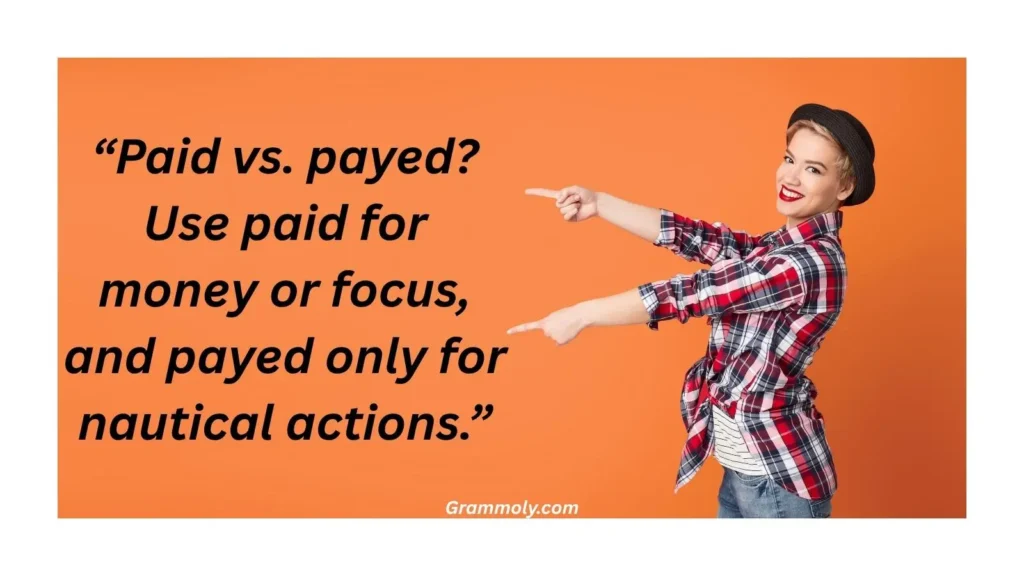
When discussing the difference between paid and payed, it is important to remember their specific uses. Generally, we use paid as the past tense of pay, while payed applies in nautical contexts. For example, sailors say “He payed the anchor,” but in everyday life, you would say, “She paid the bill.”
By keeping this distinction in mind, you can avoid common mistakes and significantly improve your English grammar. Furthermore, teachers, students, and professionals all benefit from applying this rule consistently, which ensures their writing is both polished and accurate. In addition, regular practice helps strengthen vocabulary and spelling skills.
|See more: Everywhere or every where
Paid Attention or Payed Attention – Quick Answer
- ✅ Paid attention – Correct spelling for general, financial, or transactional contexts. Example: “He paid attention during the lecture.”
- ❌ Payed attention – Incorrect for general usage; only used in nautical contexts. Example: “The sailor payed the deck with tar.”
The Origin of Paid/Payed
“The verb pay comes from the Latin pacare, meaning ‘to pacify,’ and subsequently entered English via Anglo-Norman paier. Over time, however, it developed two distinct past tense forms:”
- Paid – Standard past tense for financial and general use
- Payed – Historical past tense for nautical usage (waterproofing ships, slackening ropes)
Even today, learners confuse these forms because English has irregular verbs and varied historical spellings.
British English vs American English Spelling
Both British and American English use paid for general and financial contexts. Payed is universally restricted to nautical contexts.
| Context | Correct Form | Example |
|---|---|---|
| Financial/General | Paid | She paid attention to the teacher. |
| Nautical | Payed | He payed out the rope on the ship. |
Tip: No difference exists between US and UK English for “paid attention.”
Which Spelling Should You Use?
- US & Global Audience:
- Always use paid attention in writing, emails, or formal contexts.
- UK/Commonwealth:
- Same rule applies; use paid attention unless referencing nautical activities.
- Nautical Writing:
- Use payed only for ropes, decks, or ship maintenance.
Common Mistakes with Paid/Payed
- Writing “I payed attention in class” – ❌ Incorrect
- Using paid for ship-related tasks – ✅ Only correct if referring to money or general attention
- Confusing with other irregular verbs – Remember, pay → paid (general), pay → payed (nautical)
Paid Attention or Payed Attention in Everyday Examples
- Emails/Business Writing: “Please make sure you paid attention during the meeting.”
- News Articles: “The senator paid attention to public concerns.”
- Social Media: “I paid attention to all the updates from the event.”
- Formal Writing: “Employees paid attention to safety instructions.”
- Nautical Context: “The sailors payed the deck to prevent leaks.”
Paid Attention – Google Trends & Usage Data
- Searches for “paid attention” peak in education and workplace contexts.
- “Payed attention” shows very low search interest, mostly in historical or nautical texts.
- High US and UK searches confirm paid attention as the dominant, correct form.
Comparison Table – Variations Side by Side
| Phrase | Usage | Correct? |
|---|---|---|
| Paid attention | General, classroom, workplace | ✅ Yes |
| Payed attention | Nautical only | ✅ Limited |
| Payed attention | Financial/general | ❌ No |
People also ask
Which is correct, paid or payed?
Paid is the correct past tense of pay in everyday English. Payed is used only in rare nautical contexts.
What is the meaning of “paid attention”?
Paid attention means giving careful focus, listening closely, or noticing something important.
What does “pay attention to” mean?
It means to concentrate on, watch carefully, or listen closely to someone or something.
Why is it paid, not payed?
Because pay is an irregular verb, its standard past tense is paid. Payed is reserved for specialized maritime uses involving ropes or ships.
Conclusion
The correct form for most writing is paid attention, whether in emails, reports, social media, or news articles. Payed is a specialized term limited to nautical use, like maintaining a ship’s deck or ropes. Confusing these forms can lead to grammar mistakes and reduce clarity in professional writing.
By remembering that pay → paid (general) and pay → payed (nautical), you can avoid mistakes and improve your English grammar. Teachers, students, and professionals alike benefit from this simple rule, ensuring your writing is polished and accurate.