
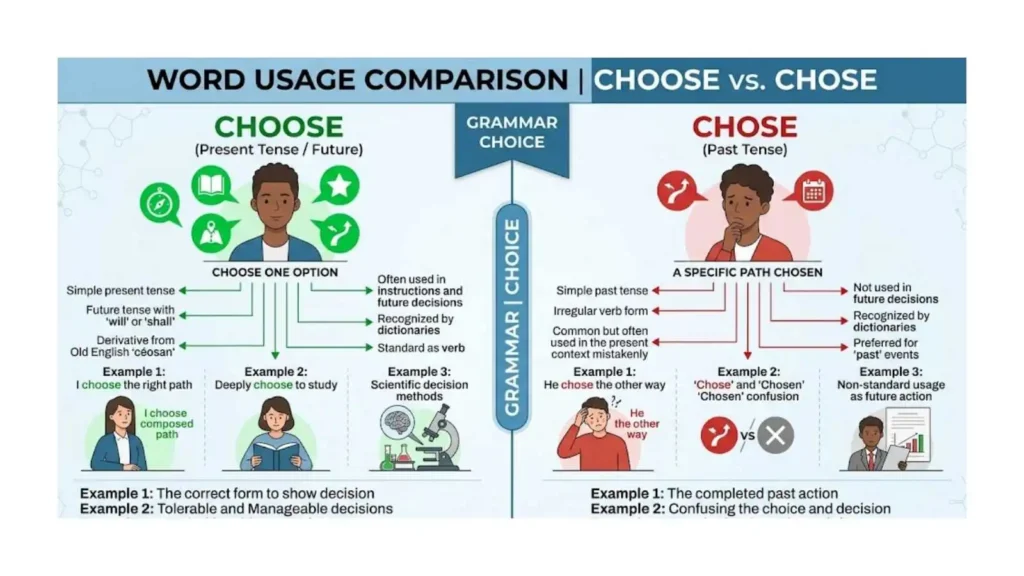
Many writers pause when deciding between choose or chose because the two words look alike but serve different grammatical purposes. This common confusion affects students, professionals, bloggers, and English learners who want clear and accurate communication. Understanding the difference between choose and chose is essential for avoiding common grammar mistakes and improving writing accuracy.
The good news is that the rule is simple once you know it. Choose is the present tense of choose, while chose is the simple past tense of choose. Learning these English verb tenses makes it easier to write emails, essays, business documents, and social media posts with confidence.
|See learn more: Fistulagram or fistulogram
This guide explains choose vs chose, covers choose meaning and chose meaning, explores their history, compares regional usage, highlights proper verb forms, and provides practical examples. By the end, you will know when to use choose, when to use chose, and how to apply these verb tense rules correctly in everyday writing.
Choose or Chose – Quick Answer
The difference is based on tense:
- Choose = Present tense
- Chose = Past tense
Examples
- I choose healthy meals every day.
- Yesterday, I chose a healthy lunch.
- They choose teamwork over competition.
- Last year, they chose a different strategy.
If the action is happening now or in the future, use choose. If it already happened, use chose.
The Meaning of Choose or Chose
What Does Choose Mean?
The word choose means to select from options or make a decision.
Examples:
- Please choose your favorite color.
- Students choose their electives carefully.
- We choose honesty and teamwork.
It often describes selecting between options, exercising judgment, or deciding on a course of action.
What Does Chose Mean?
Chose is the past tense of choose. It means the decision has already been made.
Examples:
- She chose the blue dress.
- We chose the fastest route.
- The company chose a new manager.
Choose, Chose, Chosen
Remember these forms:
| Verb Form | Example |
|---|---|
| Choose | I choose this option. |
| Chose | I chose this option yesterday. |
| Chosen | I have chosen this option. |
The Origin of Choose or Chose
The verb choose comes from the Old English word ceosan, meaning “to select,” “accept,” or “decide.” Its roots trace back to Proto-Germanic languages and evolved into the modern irregular verb we use today.
Unlike regular verbs that simply add -ed, choose follows an irregular pattern:
- Present: choose
- Past: chose
- Past participle: chosen
Because English preserves many historical verb forms, the spelling changes instead of using a regular ending.
British English vs American English Spelling
Unlike words such as organise/organize or realise/realize, there is no spelling difference between British and American English for choose and chose.
Comparison Table
| Meaning | British English | American English |
|---|---|---|
| Present tense | Choose | Choose |
| Past tense | Chose | Chose |
| Past participle | Chosen | Chosen |
Whether you write for readers in the UK, the US, Canada, Australia, or elsewhere, these spellings remain identical.
Which Spelling Should You Use?
The correct choice depends on time, not location.
Use Choose when:
- Talking about the present
- Giving instructions
- Discussing future decisions
Example:
I choose to focus on quality.
Use Chose when:
- Referring to completed actions
- Describing past decisions
- Telling historical events
Example:
They chose a new leader last month.
For international audiences, the same rule applies because both British and American English use identical spellings.
Common Mistakes with Choose or Chose
Many writers confuse these forms because they come from the same verb.
|SEE ALSO: Electric or oil heat
Incorrect
❌ Yesterday I choose pizza.
✅ Yesterday I chose pizza.
Incorrect
❌ I chose this option every day.
✅ I choose this option every day.
Incorrect
❌ Did you chose the winner?
✅ Did you choose the winner?
After did, always use the base verb choose, not chose.
Choose or Chose in Everyday Examples
“I choose to attend the afternoon meeting.”
News
“The committee chose a new director after lengthy discussions.”
Social Media
“Choose kindness every day.”
Formal Writing
“The research team chose a different methodology for the second phase.”
Academic Example
“Students choose subjects based on future career goals.”
Choose or Chose – Google Trends & Usage Data
Search interest in choose vs chose remains consistently high because it is one of the most searched commonly confused words in English.
People often search:
- choose or chose difference
- when to use choose
- when to use chose
- choose grammar
- chose grammar
- choose vs chose in English
- choose correct usage
- how to use choose correctly
- how to use chose correctly
The keyword is especially popular among students, ESL learners, teachers, and content writers looking to improve correct English usage.
Comparison Table
| Word | Function | Example |
|---|---|---|
| Choose | Present tense | I choose this book. |
| Chose | Past tense | I chose this book yesterday. |
| Chosen | Past participle | I have chosen this book. |
People also ask
- Is it correct to say “I chose”?
Yes. “I chose” is correct when referring to a decision you made in the past. - Is it chose me or choose me?
Use “choose me” for a request and “chose me” when describing a past action, such as “They chose me.” - How did you choose or chose?
The correct phrase is “How did you choose?” because did is followed by the base verb choose. - How do you use choose and chose in a sentence?
Choose: “I choose to study every evening.”
Chose: “Yesterday, I chose to stay home.” - Do I say “choose” or “chose”?
Use choose for present or future actions and chose for actions that happened in the past. - Which is right, chose or choose?
Both are correct; choose is the present tense, while chose is the past tense.
Conclusion
Understanding choose or chose becomes simple once you focus on verb tense. Choose is the present-tense form used for current or future decisions, while chose is the past-tense form used for actions that already happened. This distinction applies equally in British English and American English, making the rule universal.
Mastering these forms improves grammar, strengthens professional writing, and prevents common errors in emails, reports, essays, and online content. It also supports better communication for English learners and native speakers alike. Whenever you are unsure, ask yourself one question: “Is the decision happening now or did it happen before?” If it is happening now, use choose. If it happened in the past, use chose. Following this simple approach will help you write with confidence, consistency, and clarity.