
Quick Answer
Copyright is the correct term for legal rights over content.
Copywrite is incorrect and not a real word.
Examples:
- This article is protected by copyright.
- He registered the copyright for his book.
|Related: Manuel or manual
Meaning of Copywrite or Copyright
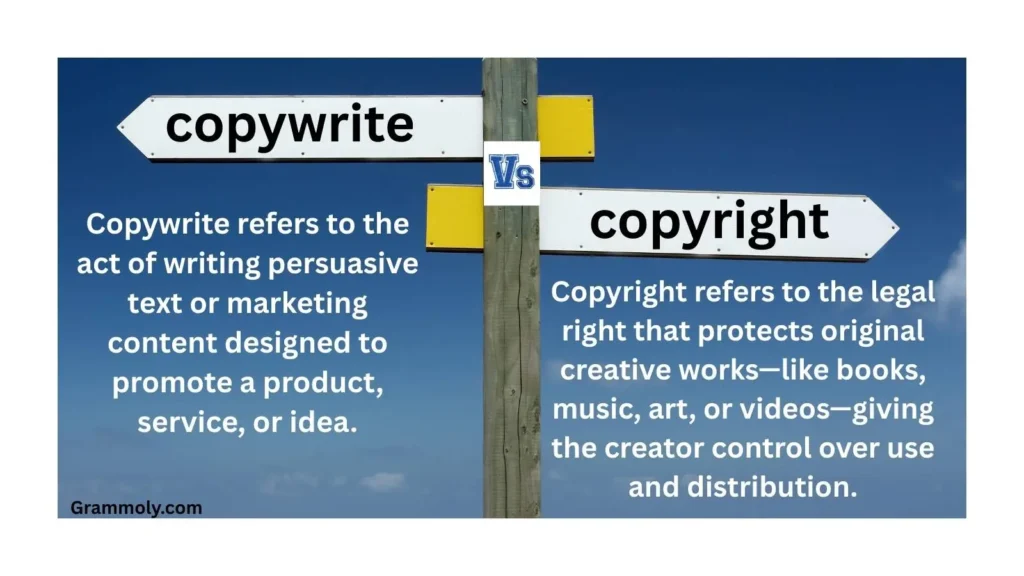
Copyright refers to a type of intellectual property rights that protects creative works, including art, music, literature, software, and videos. The owner has legal control over how the work is used, distributed, or reproduced.
Example:
- A photographer who takes a photo owns the copyright.
- A songwriter automatically has copyright to their song once it’s recorded in tangible form.
Copywriting, on the other hand, is the craft of creating persuasive content for marketing purposes. It involves:
- Writing advertisements, emails, web pages, and social media posts (digital marketing copy)
- Boosting brand awareness copy and customer engagement
- Using persuasive writing techniques to drive actions such as sales, sign-ups, or downloads
The abstract quality of copywriting is its ability to influence behavior, while copyright provides legal protection to original creative ideas.
Examples:
- Copyright: A graphic design stored digitally is protected against unauthorized use.
- Copywriting: A Facebook ad crafted to sell the same design leverages persuasive language to attract buyers.
Why People Misspell Copywrite or Copyright
Many mistakes arise because English has tricky double letters and similar-sounding words.
|See more : Peice or piece
Common typing mistakes:
- Writing “copywrite” when intending copyright
- Confusing address and success, which also involve double letters
- Swapping “copywriting” and “copyrighting” in casual writing
People often assume copywrite is related to copyright, but one refers to legal protection and the other to marketing skills. Misunderstanding this can lead to miscommunication or even legal issues when distributing creative material.
Origin of Copywrite or Copyright
The word copyright comes from “copy” + “right,” meaning the legal right to copy and protect creative work. Copywrite is a common spelling mistake and not a legal term.
Example:
- Copyright law protects books and music.
- You must respect copyright rules when using images.
FAQs
Q: Which is correct, copyright or copywrite?
A: ✅ Copyright is correct for legal protection of creative works; copywrite is incorrect in this context.
Q: What is the meaning of copywrite?
A: ✅ Copywrite refers to the act of writing marketing content, but the correct term is copywriting.
Q: Is copywrite one word?
A: ✅ Yes, it is written as one word when referring to writing copy, but copywriting is preferred.
Q: Is copywrite correct?
A: ❌ Generally, copywrite is incorrect; use copyright for legal rights or copywriting for marketing content.
Q: How do I copywrite a document?
A: ✅ You create persuasive, audience-focused content—this is properly called copywriting, not “copywriting a document.”
Q: What is the past tense for copywrite?
A: ✅ The past tense of copywriting is copywrote.
Ending
Understanding copywrite or copyright is essential for clear communication and legal accuracy. The correct term is copyright, which protects creative work under intellectual property law. In Natural Language Processing (NLP), accurate spelling improves text classification, entity recognition, and semantic analysis.
Using proper NLP techniques helps systems understand user intent and reduce errors in content processing. Modern text processing models rely on correct vocabulary to ensure high-quality results. Strong knowledge of language modeling also supports better content generation and search optimization. Therefore, learning the correct usage of copyright enhances both human writing skills and machine learning performance in real-world applications.