
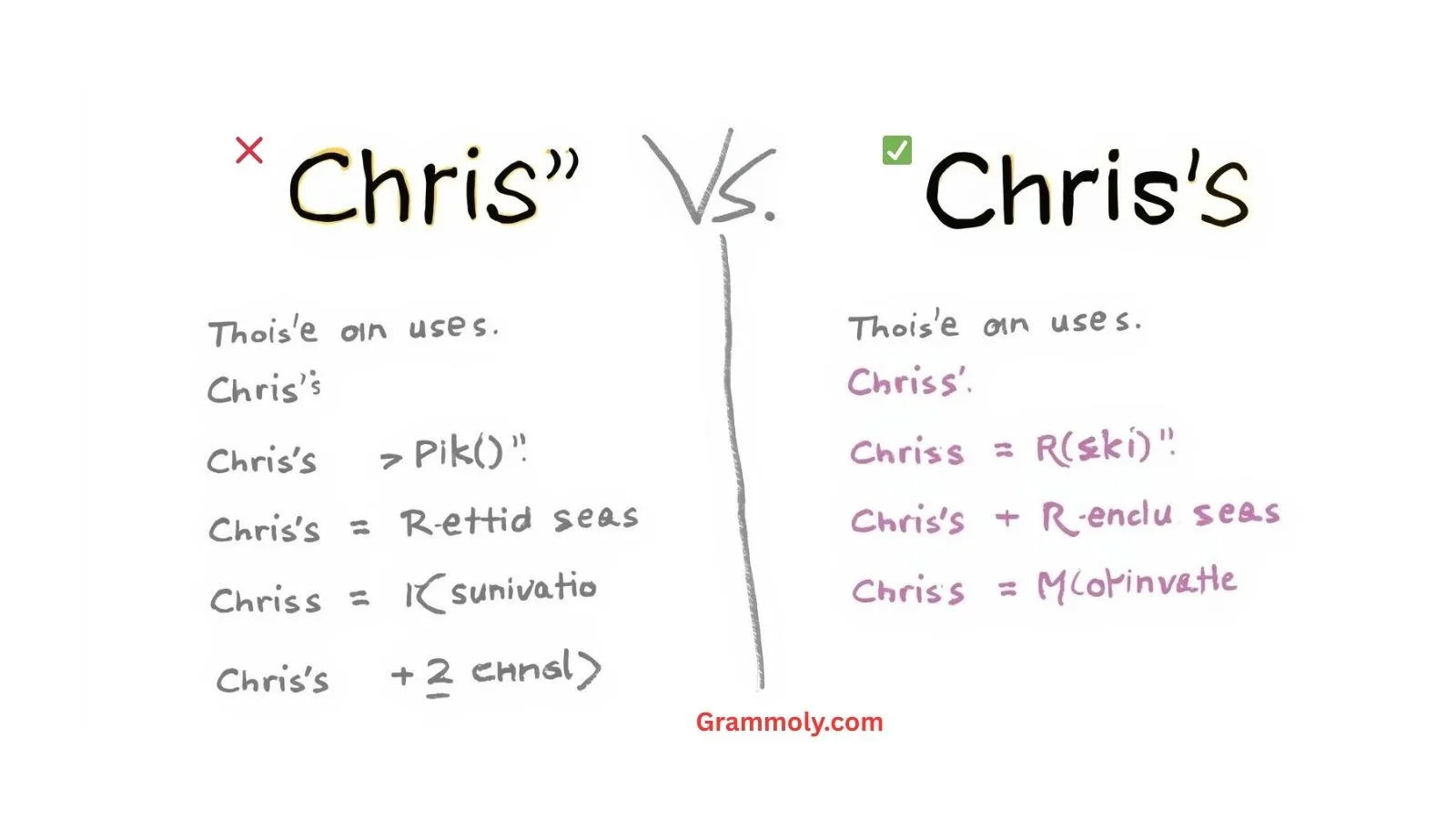
Many writers feel confused when deciding between chris’ vs chris’s while writing possessive forms in English. This confusion happens because apostrophe rules for names ending in s can vary depending on grammar style guides and writing conventions. The name Chris is a singular proper noun, so understanding proper noun possessive grammar is important for correct usage.
According to common English possessive spelling rules, writers often add an apostrophe and “s” to show ownership. However, some styles allow only an apostrophe. Learning the possessive form of Chris helps improve writing clarity and accuracy.
|See also: Useable or usable
By understanding apostrophe usage in English, writers can confidently apply correct punctuation and avoid common mistakes when forming possessive nouns in everyday communication.
Chris’ vs Chris’s – Quick Answer
The short answer: Both Chris’ and Chris’s can be correct, depending on the style guide you follow.
Most modern grammar guides recommend adding apostrophe + s for singular possessive nouns, even when the name ends in s.
Examples
- Chris’s car is parked outside.
- Chris’s laptop was left at the office.
However, the Associated Press (AP) Stylebook prefers using only an apostrophe:
- Chris’ car is parked outside.
Quick Comparison
| Form | Example | Style Preference |
|---|---|---|
| Chris’s | Chris’s phone rang during the meeting. | Chicago Manual, British English |
| Chris’ | Chris’ phone rang during the meeting. | AP Style |
So if you are wondering “is it Chris’s or Chris’?”, the answer is that both are acceptable, but the style guide determines which one you should use.
The Origin of Chris’ vs Chris’s
The confusion around chris’ vs chris’s comes from historical grammar rules for apostrophes. Early English writers used apostrophes to show ownership, which became known as the possessive case of proper nouns.
Originally, possessive forms were created by adding “’s” to a noun. Over time, some writers began dropping the extra s for words already ending in s.
|See more: Kaftan or caftan
This created two traditions:
- Add apostrophe + s for singular names (Chris’s)
- Add apostrophe only when the word ends with s (Chris’)
Modern grammar systems try to standardize these differences using English grammar apostrophe rules explained in style guides such as AP Style and the Chicago Manual of Style.
Because Chris refers to one person, it follows the singular possessive nouns rule, not the plural possessive nouns examples rule.
British English vs American English Spelling
Spelling and punctuation rules often vary between regions. The difference between Chris’s and Chris’ can depend on whether the writing follows British or American conventions.
American English
American English often follows style guides like AP Style or Chicago Manual of Style.
- Chicago style: Chris’s
- AP style: Chris’
British English
British English usually prefers apostrophe + s for singular nouns.
- Chris’s house
- James’s car
Comparison Table
| Region | Preferred Form | Example |
|---|---|---|
| American English (Chicago Style) | Chris’s | Chris’s office is on the second floor. |
| American English (AP Style) | Chris’ | Chris’ office is on the second floor. |
| British English | Chris’s | Chris’s office is on the second floor. |
These rules explain how style guides treat Chris’s or Chris’ in professional writing.
Which Spelling Should You Use?
Choosing the correct spelling depends on your audience.
If you write for American audiences
Use the style required by the organization.
- News writing → Chris’
- Academic or general writing → Chris’s
If you write for UK or Commonwealth audiences
The safer option is Chris’s, because it follows common punctuation rules for possessives in British English.
If your audience is global
The most widely accepted option is Chris’s because it matches the proper way to write possessive names in many grammar systems.
Consistency is important. Choose one spelling and use it throughout the document.
Common Mistakes with Chris’ vs Chris’s
Many writers make mistakes when applying apostrophe rules for names ending in s.
Mistake 1: Using an apostrophe for plural nouns
❌ Chris’s are coming to dinner.
✔ The Chrises are coming to dinner.
Error 2: Adding an extra “s” to plural possessives
❌ The parents’s house
✔ The parents’ house
Mistake 3: Mixing both forms in the same article
❌ Chris’ car is new. Chris’s laptop is old.
✔ Choose one style and keep it consistent.
These mistakes often happen because people misunderstand how to form possessive nouns in English.
Chris’ vs Chris’s in Everyday Examples
Understanding the correct possessive form of Chris becomes easier with real examples.
Hi Alex,
Please return Chris’s report before the meeting tomorrow.
News Writing
The conference will be held in Chris’ office this afternoon.
Social Media
Just finished dinner at Chris’s restaurant—great food!
Formal Writing
The project proposal was reviewed in Chris’s department.
These examples show how correct apostrophe placement helps maintain clarity.
Chris’ vs Chris’s – Google Trends & Usage Data
Online searches show that many people are confused about how to write Chris possessive form.
Search queries:
- should I use Chris’s or Chris’
- how to write names ending in s possessive
- apostrophe after names ending in s
Usage Trends
- Chris’s appears more often in books and academic writing.
- Chris’ appears more frequently in journalism because of AP style.
Countries like the United States, United Kingdom, Canada, and Australia regularly search for this grammar topic.
This trend shows how important possessive nouns in English grammar are for writers and students.
FAQ: Chris’ vs Chris’s
What is correct, James or James’s?
Both are correct; James’s is preferred for singular possessive, but James’ is accepted in some style guides.
Is it correct to say “a friend of John’s”?
Yes, this is correct and shows possession using the apostrophe + s form.
Is it Jones or Jones’s?
Both are acceptable; Jones’s follows singular possessive rules, while Jones’ follows AP Style.
Do you use s or s’s?
For singular nouns ending in s, use ’s (Chris’s), unless a style guide says otherwise.
Which is correct, Chris’s or Chris?
Chris’s is correct for possession; just “Chris” without an apostrophe is not possessive.
Is it correct to say “s’s”?
Yes, it is correct for singular nouns ending in s, e.g., Chris’s book.
Execution
In conclusion, understanding chris’ vs chris’s helps writers apply the correct possessive form of names ending in s. Many people wonder is it Chris’s or Chris’ when writing emails, articles, or reports. Knowing how to write Chris possessive form ensures clarity and professionalism in all types of communication. Following the rules of correct possessive form of Chris prevents errors in grammar and punctuation.
Writers also often ask should I use Chris’s or Chris’, especially when switching between style guides. By learning how style guides treat Chris’s or Chris’, you can maintain consistency, improve readability, and confidently use possessive nouns in English grammar every time.