
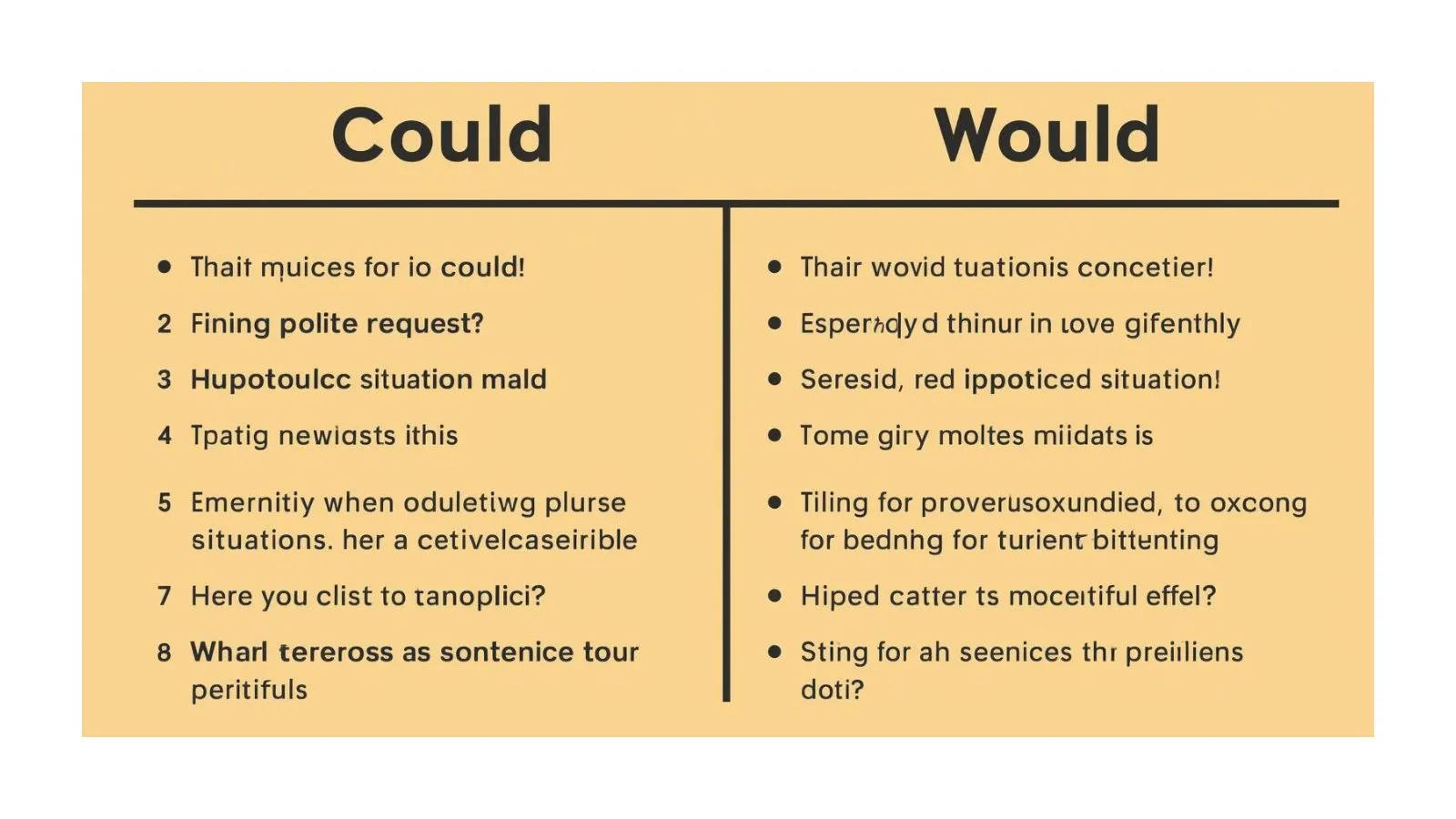
It can be challenging to learn when to use could or would in English grammar. These auxiliary verbs aid in expressing possibility, preference, hypothetical circumstances, and courteous requests. Writing clearly and professionally requires knowing how to utilize could or would.
|Related: Has vs have
What Do “Could” and “Would” Mean?
Both could and would are auxiliary verbs, commonly referred to as modal verbs. Understanding their meanings and functions is essential for effective communication.
Could
Could is traditionally considered the past tense of can, but it also expresses:
- Possibility: “The weather could change later today.”
- Ability in the past: “When I was young, I could run very fast.”
- Tentativeness or politeness: “I could be mistaken, but I think the meeting starts at 2 PM.”
- Hypothetical situations: “You could try the new software if you like.”
Would
Would is technically the past tense of will, yet it is used in both past and present contexts:
- Polite requests:
- “Would you pass the salt?”
- Hypothetical outcomes:
- “I would travel more if I had extra time.”
- Habitual past actions:
- “Every morning, she would take a walk before breakfast.”
- Expressing preference:
- “I would rather read a book than watch TV.”
- Expressing desire or intention:
- “He said he would help with the project.”
These verbs allow English speakers to express doubt, intention, preference, and other nuanced meanings, making them essential tools in both written and spoken communication.
British vs American English: Spelling Differences
A common source of confusion arises from the spelling differences between British and American English. Words that use “-ise” in British English often appear as “-ize” in American English. While these differences do not change the meaning, they can affect the perception of professionalism in writing.
Examples :
| British English | American English |
|---|---|
| organise | organize |
| realise | realize |
| recognise | recognize |
| apologise | apologize |
This rule extends to verbs commonly used with could and would when forming indirect statements, polite requests, or conditional sentences, especially in formal writing.
How Spell Checkers Depend on Language Settings
Modern word processors and spell checkers automatically adjust suggestions based on the selected language setting. Choosing the wrong language can lead to incorrect suggestions or missed errors.
Instance:
- Writing realise in a US English document may trigger a warning, suggesting realize.
- Conversely, writing apologize in a UK English document may prompt a correction to apologise.
Tip:
Being aware of these settings ensures that your grammar and spelling remain consistent, maintaining clarity and credibility.
Similar Verbs to Remember
Many verbs in English follow the “-ise/-ize” pattern. Here are a few notable ones often used alongside could and would:
- Recognise / Recognize – “She would recognize him immediately if she saw him.”
- Organise / Organize – “We could organize a meeting next week.”
- Realise / Realize – “He would realize the mistake too late.”
- Apologise / Apologize – “I could apologize for the misunderstanding.”
Understanding these subtle differences improves the readability of your text and ensures consistency across different English variants.
Why Choosing the Correct Spelling Matters
Correct spelling is more than a technical detail—it is a marker of professionalism and credibility. Whether you are writing emails, academic papers, or blog posts:
- Inconsistent spelling may confuse readers or create doubt about your attention to detail.
- Using the correct variant of -ise/-ize demonstrates knowledge of regional conventions.
- Correct usage of could and would ensures your sentences convey the intended meaning, whether expressing polite requests, obligation and advice, hypothetical outcomes, or future likelihoods.
For English learners, maintaining awareness of these rules aligns your writing with both formal and informal English usage, enhancing overall communication skills.
Tips for Using “Could” and “Would” Correctly
- Polite Requests in English: Use would or could for courteous phrasing.
- “Would you mind closing the window?”
- “Could you help me with this task?”
- Hypothetical Situations: Express imagined or potential outcomes.
- “I would travel more if I could afford it.”
- “She could have joined us if she wanted.”
- Expressing Doubt or Tentativeness in English:
- “I would assume he’s arriving soon.”
- “This could be the solution we need.”
- Habitual and Repetitive Past Actions:
- “Every summer, they would visit the seaside.”
- “The clock could chime every hour.”
- Obligation, Advice, and Preference Expressions:
- “You should brush your teeth daily.”
- “I would rather take the train than fly.”
- Expressing Desire, Intention, or Possible Future Events:
- “He said he would finish the work by tomorrow.”
- “We could see better results with a structured plan.”
- Conditional Sentences Examples:
- “If I could, I would join the team.”
- “I would have helped if I had known earlier.”
Using could and would appropriately enhances both spoken and written clarity, especially for learners following grammar TIP sheets or English modals for beginners.
FAQs
- When should I use could and would?
Use could for ability, possibility, or polite requests; would for hypothetical situations, preference, or polite offers. - Is it better to say “would you” or “could you”?
Both are polite; “would you” implies willingness, “could you” emphasizes ability. - What is the difference between could and would in requests?
Could asks if someone is able, would asks if someone is willing to do it. - Is it more polite to say “would” or “could”?
Both are polite, but “would” is slightly more courteous when requesting willingness. - Which is more respectful, could or would?
Would is generally more respectful, as it focuses on the person’s choice or willingness. - What’s better, would or could?
It depends: use could for ability or possibility, would for willingness, preference, or hypotheticals.
Conclusion
Mastering could and would goes beyond memorizing rules—it involves understanding context, intention, and subtle nuances in meaning. Combined with awareness of British vs American spelling conventions, particularly the “-ise/-ize” distinction, you can write confidently and professionally.
Paying attention to spell check settings, similar verbs like organise/organize or realise/realize, and correct usage in hypothetical situations, polite statements, and conditional sentences ensures your English communication remains precise and credible.