
Quick Answer
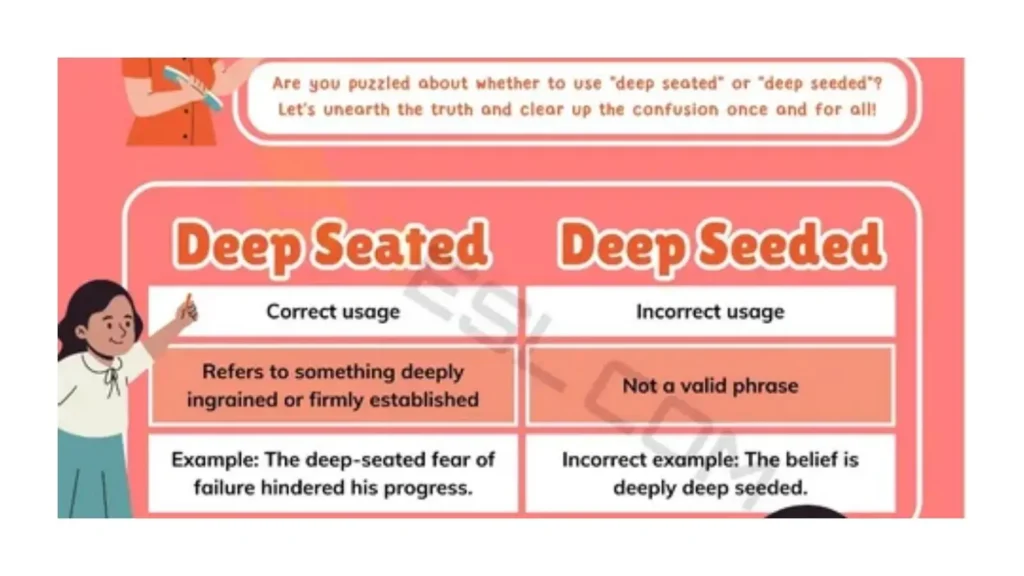
✅ Deep-seated is the correct phrase.
❌ Deep-seeded is a common misspelling.
The phrase deep-seated describes something firmly established, strongly rooted, or difficult to change.
Examples
✅ She has deep-seated fears about failure.
✅ The country faced deep-seated social problems.
❌ She has deep-seeded fears about failure.
Easy rule:
If something is firmly fixed emotionally, mentally, or socially, use deep-seated.
|See also: Garbage shoot or chute
Meaning of Deep-Seated vs Deep-Seeded
What Does “Deep-Seated” Mean?
The term deep-seated means firmly established or strongly rooted over time.
It often describes:
- Beliefs
- Emotions
- Habits
- Problems
- Fears
- Traditions
Examples
- He carried deep-seated anger for years.
- The company had deep-seated management issues.
The phrase suggests something difficult to remove or change.
What Does “Deep-Seeded” Mean?
“Deep-seeded” is generally incorrect in standard English.
People mistakenly connect the phrase with seeds growing deeply in soil. Although the image sounds logical, dictionaries and grammar guides recognize only deep-seated as correct.
Why People Misspell Deep-Seated vs Deep-Seeded
English spelling confusion often happens because words sound similar.
|See learn more: Kaftan or caftan
Sound-Based Confusion
When spoken quickly, “seated” and “seeded” can sound alike.
This causes many writers to type the wrong version.
Mental Association with Seeds
People often imagine ideas “growing like seeds,” which makes “deep-seeded” seem reasonable emotionally.
However, the original phrase relates to something “sitting deeply,” not planting seeds.
English Double-Letter Confusion
English contains many confusing spellings involving repeated letters and pronunciation differences.
Examples
- Address
- Success
- Committee
- Necessary
These irregular patterns cause typing mistakes and spelling uncertainty.
Common Typing Mistakes
Writers commonly type:
❌ Deep-seeded beliefs
❌ Deep seeded fears
Correct forms are:
✅ Deep-seated beliefs
✅ Deep-seated fears
The Origin of Deep-Seated
The phrase deep-seated comes from the verb seat, meaning “to place firmly.”
Historical Meaning
Originally, “seated” described something positioned securely or permanently.
Over time, English speakers began using “deep-seated” figuratively for emotions, ideas, and social problems rooted deeply in people or society.
Etymology
The word “seat” comes from Old English setl, meaning:
- Position
- Place
- Fixed location
This explains why “deep-seated” means firmly established rather than planted like a seed.
Why “Deep-Seeded” Became Popular
The mistake developed because “seed” feels visually connected to growth and roots.
This type of language confusion is called an “eggcorn” — a mistaken phrase that sounds logical but is grammatically incorrect.
British English vs American English Spelling
Both British and American English use:
✅ Deep-seated
Neither spelling system accepts “deep-seeded” as standard.
Comparison Table
| Phrase | British English | American English |
|---|---|---|
| Deep-seated | Correct | Correct |
| Deep-seeded | Incorrect | Incorrect |
Which Spelling Should You Use?
Professional Writing
Always use:
✅ Deep-seated
This is the accepted form in:
- Academic writing
- Journalism
- Business communication
- Books
- Professional emails
Casual Writing
Some people still write “deep-seeded,” but editors usually correct it.
Global English
“Deep-seated” is universally recognized and recommended.
Common Mistakes with Deep-Seated vs Deep-Seeded
Thinking “Seeded” Is Correct
The phrase is not connected to planting seeds.
❌ Deep-seeded
✅ Deep-seated
Removing the Hyphen
Correct form:
✅ Deep-seated
Incorrect form:
❌ Deep seated
The hyphen improves clarity in compound adjectives.
Using the Wrong Context
“Deep-seated” mainly describes emotional, mental, social, or structural conditions.
Deep-Seated in Everyday Examples
Emails
- The company faces deep-seated financial issues.
News Writing
- The nation continues battling deep-seated inequality.
On Social Media
- Deep-seated fears can affect confidence daily.
In Formal Writing
- Researchers examined deep-seated cultural beliefs.
Interesting Facts About Deep-Seated
- “Deep-seeded” is one of the most common English eggcorn errors.
- Many educated writers accidentally use the wrong form.
- Search engines now recognize both phrases because of frequent mistakes.
- “Deep-seated” has existed for centuries in English literature.
Language changes constantly, but grammar standards still matter in professional communication.
Summary
The difference between Deep-Seated vs Deep-Seeded is simple once you know the origin. Deep-seated is the only correct phrase in standard English. It describes emotions, beliefs, fears, or problems that are firmly established and difficult to change.
The incorrect form “deep-seeded” became popular because people associate ideas with seeds and growth. However, the phrase actually comes from “seat,” meaning fixed firmly in place. Using the correct form improves writing clarity, professionalism, and grammar accuracy.
People also ask
What are deep seeded issues?
“Deep seeded issues” is usually a mistaken form of “deep-seated issues,” meaning problems that are strongly rooted and hard to change.
Is it deep-seated or deep seeded reddit?
The correct phrase is “deep-seated,” even though many Reddit users mistakenly write “deep seeded.”
Is it deep-seated or deep seeded infection?
“Deep-seated infection” is correct because it describes an infection deeply established inside the body.
Where does the term “deep-seated” come from?
It comes from the word “seat,” meaning firmly fixed or positioned deeply over time.
Which is correct, deep seeded or deep seated?
“Deep-seated” is the correct standard English phrase.
Why do Brits say “let’s have it”?
British speakers use “let’s have it” to mean “say it,” “show it,” or “get to the point.”
What’s another way to say “deep seated”?
You can say deeply rooted, firmly established, ingrained, embedded, or long-standing.
How did sailors use the term Deep Six?
Sailors used “deep six” to mean throwing something overboard into deep water, especially beyond six fathoms.