
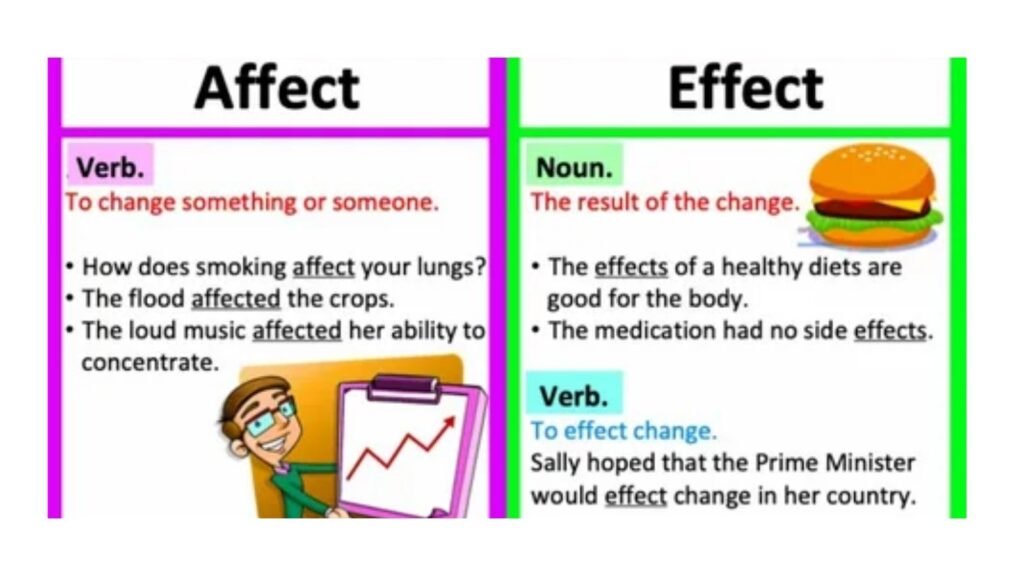
Understanding affect vs effect can instantly improve your writing and eliminate common grammar mistakes. Many learners confuse these terms because they sound alike but have different meanings. Learning word choice, English grammar, verb vs noun, writing accuracy, and language usage helps you communicate more clearly.
Whether you’re writing emails, essays, or reports, mastering this distinction builds confidence and ensures your message is both professional and easy to understand.
|RELATED: Has vs have
Affect vs Effect – Quick Answer
The quickest way to remember the difference is:
- Affect = usually a verb meaning to influence or change.
- Effect = usually a noun meaning a result or outcome.
Examples:
- The weather affected our travel plans.
- The new policy had a positive effect on productivity.
Quick Comparison
| Word | Part of Speech | Meaning | Example |
|---|---|---|---|
| Affect | Verb | To influence | Stress can affect sleep. |
| Effect | Noun | A result or consequence | The medicine had little effect. |
The Origin of Affect vs Effect
Both words originated from the Latin verb facere, meaning “to make” or “to do,” but they developed different meanings over time.
- Affect: comes from the Latin afficere, meaning “to influence or act upon.”
- Effect: comes from the Latin effectus, meaning “an accomplishment or result.”
Because they share similar roots and spellings, writers frequently confuse them. Their nearly identical pronunciation in many accents also contributes to the mistake.
British English vs American English Spelling
Unlike pairs such as organise/organize or realise/realize, affect and effect are not spelling variants. Both British and American English use the same spellings and meanings.
| British English | American English | Correct Usage |
|---|---|---|
| affect | affect | To influence |
| effect | effect | Result or outcome |
The distinction is grammatical rather than regional.
Which Word Should You Use?
Your choice depends on meaning, not location.
US audiences
Use affect when describing influence and effect when referring to a result.
UK and Commonwealth audiences
The same rule applies. British publishers and educational institutions follow identical usage.
Global English
The standard guidance remains unchanged:
- Use affect for actions that influence.
- Use effect for outcomes or consequences.
Common Mistakes with Affect vs Effect
Here are some frequent errors and their corrections:
❌ The new rules will effect attendance.
✅ The new rules will affect attendance.
❌ The new training had a positive affect.
✅ The new training had a positive effect.
Pollution has many harmful affects.❌
Pollution has many harmful effects.✅
A simple memory trick is:
- Affect = Action (verb)
- Effect = End Result (noun)
Affect vs Effect in Everyday Examples
|SEE ALSO: which vs that
Emails
- The delay may affect our delivery schedule.
- The change had no negative effect on customers.
Social Media
- Exercise can positively affect your mood.
- The campaign had a huge effect online.
News Reports
- Heavy rainfall affected local transportation.
- The policy’s effects will be reviewed next year.
Formal Writing
- Economic conditions may affect investment decisions.
- Researchers measured the long-term effects of pollution.
Affect vs Effect – Google Trends & Usage Data
Search interest in affect vs effect remains consistently high because it is one of the most commonly confused word pairs in English.
|See more: Lint or lent
People frequently search for:
- affect or effect
- difference between affect and effect
- affect vs effect examples
- when to use affect
- when to use effect
The topic is especially popular among students, professionals, job applicants, and English language learners in countries such as the United States, the United Kingdom, Canada, Australia, and India.
FAQs
- Is it affects me or effects me?
The correct phrase is “affects me” because affect is usually the verb meaning “to influence.” - What is the trick to remember affect vs effect?
A simple trick is: Affect = Action (verb) and Effect = End result (noun). - What does “affect” mean?
Affect means to influence, change, or have an impact on someone or something. - Are you effected or affected by something?
In most cases, “affected” is correct because it means influenced or impacted by something. - How do I use effect vs affect?
Use affect when talking about influencing something and effect when referring to the result or outcome. - How is effected different from affected?
Effected means brought about or caused, while affected means influenced or changed by something.
Conclusion
In conclusion, mastering affect vs effect strengthens correct English usage, grammar rules, verb and noun differences, writing clarity, common confused words, and professional communication.
By understanding their meanings and practicing with examples, you can avoid frequent mistakes and write with greater confidence, precision, and credibility in both academic and everyday situations.