
Quick Answer
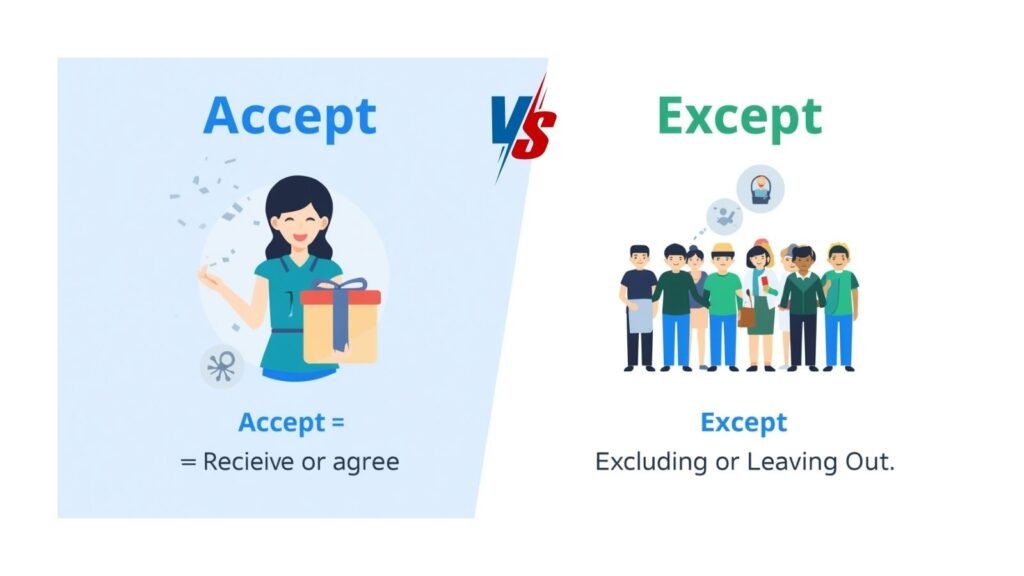
Accept means to receive, agree to, or approve something, while except means to exclude or leave out. Although the words sound similar, they have completely different meanings and uses.
|SEE LEARN MORE: Focussing or focusing
Examples:
- I accept your invitation.
- Everyone came except Sarah.
Understanding accept vs except helps you avoid one of the most common English grammar mistakes.
Meaning of Accept vs Except
What Does “Accept” Mean?
The verb accept means to receive, agree to, approve, or believe something willingly. It often relates to offers, invitations, responsibility, or facts.
Examples:
- She accepted the job offer.
- They accepted the apology.
- I accept your decision.
What Does “Except” Mean?
The word except is usually a preposition or conjunction meaning excluding or other than. It identifies something or someone left out of a group.
Examples:
- Everyone passed the exam except Tom.
- I like all fruits except bananas.
- The store is open every day except Sunday.
Why People Misspell or Confuse Accept vs Except
Many English learners mix up accept and except because they sound almost identical when spoken. This confusion is similar to mistakes involving words with double letters, such as address, success, necessary, or committee, where spelling patterns create uncertainty.
Typing quickly, relying on autocorrect, or focusing only on pronunciation can also lead to errors. Fortunately, remembering that accept = receive and except = exclude makes the distinction much easier.
Origin of the Words
Both words trace their history to Latin but evolved with different meanings.
- Accept:
- Comes from the Latin acceptare, meaning “to receive willingly” or “to welcome.”
- Except:
- Comes from the Latin exceptus, meaning “taken out” or “excluded.”
Although they share similar roots and pronunciation, centuries of language development gave them separate definitions and grammatical roles.
Accept vs Except in Everyday Writing
Here are common situations where each word appears:
Using “Accept”
- Accept an invitation
- Accept payment
- Accept responsibility
- Accept a challenge
- Accept an offer
Using “Except”
- Everyone except me
- Open every day except Monday
- Nothing except water
- All students except one
- No pets except service animals
Common Mistakes to Avoid
❌ I except your apology.
✅ I accept your apology.
Everyone accept John attended.❌
Everyone except John attended.✅
❌ She accepted everyone except herself.
✅ Correct usage depends on whether you mean “received” or “excluded.”
|SEE ALSO: Threading or tweezing
Tips to Remember the Difference
- Accept = Agree or Receive
- Except = Exclude or Leave Out
A simple trick:
- A in Accept = Agree
- Ex in Except = Exclude
Interesting Facts
- “Accept” is always used as a verb.
- “Except” is commonly used as a preposition but can also function as a conjunction or verb in rare contexts.
- Both words are among the most frequently confused pairs in English writing tests.
- Spell checkers usually won’t catch misuse because both are correctly spelled English words.
Summary
Once you understand what they represent, it’s easy to distinguish between accept and except. Except denotes excluding or leaving out, whereas accept denotes receiving or agreeing.
You may choose the right term and enhance your written and spoken English by paying attention to context.
People also ask
- Is it accept or except my apology?
The correct phrase is “accept my apology” because accept means to receive or forgive. - How do you use except in a sentence?
Use except to mean “excluding,” as in: Everyone attended the meeting except John. - How do you use “accept” in a sentence?
Use accept when receiving or agreeing to something, for example: She decided to accept the job offer. - Why do people pronounce accept as except?
People may confuse them because accept and except sound very similar in spoken English, even though they have different meanings and spellings.
