
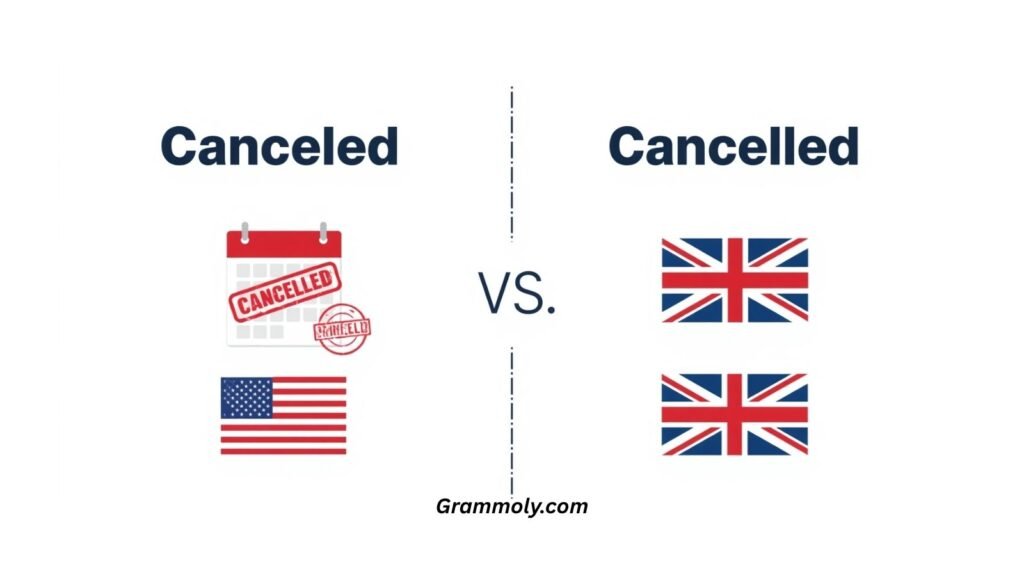
Have you ever typed “canceled” and wondered whether you should write “cancelled” instead? You’re not alone. Many people search for this grammar question because books, newspapers, emails, and websites use both spellings. This common confusion often leaves writers unsure which version best fits their audience or writing style.
Rather than grammatical errors, the misconception stems from regional spelling practices. British English typically favors cancelled, although American English prefers canceled.
|RELATED: Affect vs effect
Professionals, bloggers, business writers, and students can create polished content for their target audience by understanding this spelling difference. This guide explains the key distinctions, explores the history of both spellings, compares US and UK usage, highlights common mistakes, and provides practical examples to help you choose the correct version with confidence every time.
Canceled or Cancelled – Quick Answer
The answer depends on the variety of English you use.
- Canceled : Preferred in American English
- Cancelled : Preferred in British English, Canadian English, Australian English, and many Commonwealth countries
Examples
- ✅ The flight was canceled due to bad weather. (US)
- ✅ The football match was cancelled because of heavy rain. (UK)
Both spellings are correct when used for the appropriate audience.
The Origin of Canceled or Cancelled
Historically, the verb cancel comes from the Latin word cancellare, meaning “to cross out” or “to strike through.” Later, it entered English through Old French and eventually became part of everyday vocabulary.
As a result, the word evolved into the widely used term we recognize today.
The spelling difference developed because American English often simplifies doubled consonants in certain words, while British English tends to preserve them. As a result, Americans commonly write canceled, whereas British writers usually write cancelled.
British English vs American English Spelling
The primary distinction is regional preference.
| American English | British English |
|---|---|
| canceled | cancelled |
| canceling | cancelling |
| traveler | traveller |
| labeled | labelled |
| modeling | modelling |
Although the spellings differ, the meaning remains exactly the same.
|SEE ALSO: Accept vs except
Which Spelling Should You Use?
Choose your spelling based on your audience.
your audience is in the United States:
Use canceled and canceling.
your audience is in the United Kingdom, Australia, Canada, or New Zealand:
Use cancelled and cancelling.
your audience is global:
Remain consistent throughout your document. Mixing both spellings can appear unprofessional.
Common Mistakes with Canceled or Cancelled
Here are mistakes writers frequently make:
❌ The company cancelled the meeting yesterday. (US style guide)
✅ The company canceled the meeting yesterday.
The airline canceled our flight. (UK publication following British spelling)❌
The airline cancelled our flight.✅
❌ Mixing “canceled” and “cancelled” in the same article.
✅ Stick to one regional style consistently.
Canceled or Cancelled in Everyday Examples
Emails
✅ We canceled your appointment due to maintenance.
✅ The organizers cancelled the conference until next month.
Social Media
- The concert was canceled, and fans were disappointed.
- Our picnic has been cancelled because of the storm.
News Headlines
- Following a technical inspection, the flight was canceled.
- Meanwhile, train services were cancelled across northern regions due to ongoing disruptions.
Formal Writing
- The contract was canceled before signing.
- The scheduled event was cancelled following safety concerns.
Canceled or Cancelled – Google Trends & Usage Data
Search interest in “canceled or cancelled” remains consistently strong because users frequently encounter both spellings online.
- Canceled:
- Dominates searches and publications in the United States.
- Cancelled:
- Is more common in the United Kingdom, Australia, Canada, and many Commonwealth countries.
Quick Comparison Table
| Feature | Canceled | Cancelled |
|---|---|---|
| Meaning | Called off or stopped | Called off or stopped |
| Region | American English | British/Commonwealth English |
| Correct? | Yes | Yes |
| Preferred by | US publications | UK, Canada, Australia, NZ |
| Pronunciation | Same | Same |
People also ask
- Is it canceled or canceled for USA?
In the USA, “canceled” is the preferred and correct spelling. - What does “canceled” mean?
Canceled means something has been called off, stopped, or decided not to happen. - Is it cancelled or canceled in Australia?
In Australia, “cancelled” with a double L is the standard spelling. - Is it cancelled or canceled appointment?
Both are correct depending on the audience: “canceled appointment” (US) and “cancelled appointment” (UK/Australia). - Which is correct, canceled or canceled?
The two words are identical as written; “canceled” is the standard American English spelling. - How do I say “cancel my appointment”?
You can simply say, “I would like to cancel my appointment, please.”
Summary
Ultimately, master canceled or cancelled by choosing the spelling that matches your audience and writing style. By doing so, you can improve English spelling, strengthen writing consistency, follow American English, respect British English, and avoid common grammar mistakes with confidence.
Furthermore, always check your style guide, apply the correct form consistently, and produce clear, professional content that readers trust.