
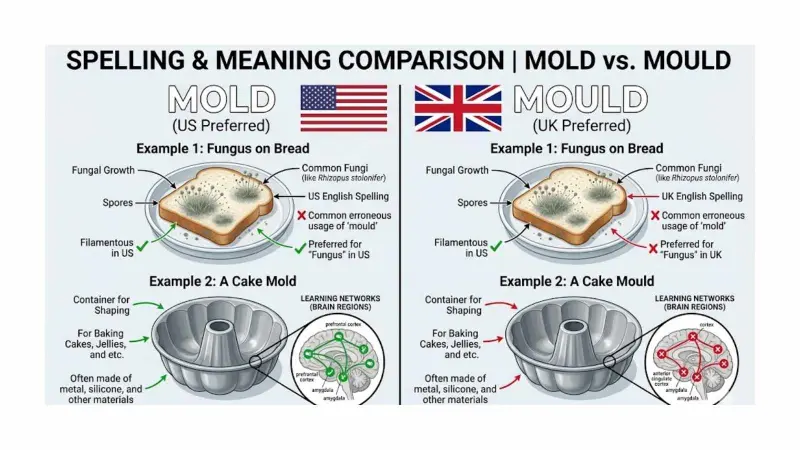
Many writers wonder whether to use mold or mould because both spellings appear in books and online content. Understanding American English spelling, British English spelling, regional spelling differences, grammar rules, and writing consistency helps you choose the correct version.
|See also: Traveler or traveller
Knowing when to use each form improves clarity, strengthens credibility, and ensures your writing matches the expectations of your target audience.
What Do “Mold” and “Mould” Mean?
The words mold and mould have identical meanings. They can refer to:
- A type of fungus that grows in damp environments.
- A hollow container used to shape materials.
- The act of shaping or forming something.
Examples
- Bread can develop mold if stored improperly.
- A baker pours chocolate into a mould.
- Artists mold clay into sculptures.
Despite the spelling difference, the pronunciation and meaning remain the same.
British English vs American English Spelling
The primary distinction is regional.
| American English | British English |
|---|---|
| Mold | Mould |
| Moldy | Mouldy |
| Molding | Moulding |
Example Sentences
- US: The wall has visible mold.
- UK: The wall has visible mould.
Both versions are grammatically correct.
Origin of the Word
The term comes from Old English and Germanic roots associated with shaping or forming objects and with natural organic growth. Over centuries, spelling conventions evolved differently across regions.
When American English simplified many spellings during language standardization, mold became the preferred US form. British English retained mould, preserving the historical ou spelling found in many traditional words.
How Spell Checkers Affect Usage
Modern spell checkers depend on language settings.
- If your software is set to US English, it will recommend mold.
- If it uses UK English, it will often suggest mould.
Neither suggestion is inherently wrong. The key is matching your chosen variety of English and staying consistent throughout your writing.
|SEE MORE: Judgment or judgement
Similar Regional Spelling Differences
English contains many regional spelling variations similar to mold or mould, including:
- organise / organize
- realise / realize
- recognise / recognize
- apologise / apologize
These pairs demonstrate how British and American English often differ while preserving identical meanings.
Common Mistakes
Mixing Spellings
❌ The basement has mold, and the walls contain mould.
✅ Use one style consistently throughout your document.
Assuming One Is Incorrect
Many writers mistakenly believe mould is wrong or outdated. In reality, it remains standard British English.
Ignoring Audience
Choosing the spelling that matches your readers improves professionalism and clarity.
Why Correct Spelling Matters
Using the appropriate regional spelling:
- Improves credibility
- Builds reader trust
- Maintains consistency
- Meets publishing guidelines
- Creates a polished appearance
Businesses, educators, and content creators often follow a style guide to ensure consistent language.
Practical Examples
Home Inspection
- US: The inspector found black mold behind the wall.
- UK: The inspector found black mould behind the wall.
Cooking
- US: Pour the mixture into the cake mold.
- UK: Pour the mixture into the cake mould.
Art
- The sculptor used a silicone mold/mould to create identical pieces.
Tips
- Mold = American English
- Mould = British English
If your audience is global, choose one version and use it consistently.
FAQs
- Is it mould or mold to shape?
Both are correct: use mold in American English and mould in British English when referring to shaping something. - Is it mould or mold cast?
In the US, write mold cast; in the UK and many Commonwealth countries, mould cast is preferred. - Is it mold or mould for fungus?
Both spellings refer to the fungus. Mold is standard in American English, while mould is standard in British English. - Does mould mean shape?
Yes. Mould can mean to shape or form something, or it can refer to the container used to create that shape.
Conclusion
Choosing between mold or mould depends on your audience and preferred English style. By following US vs UK spelling, maintaining writing consistency, understanding regional language differences, applying correct grammar usage, and using professional writing standards, you can communicate clearly and confidently. Pick one spelling, stay consistent, and produce polished content that readers trust.
