
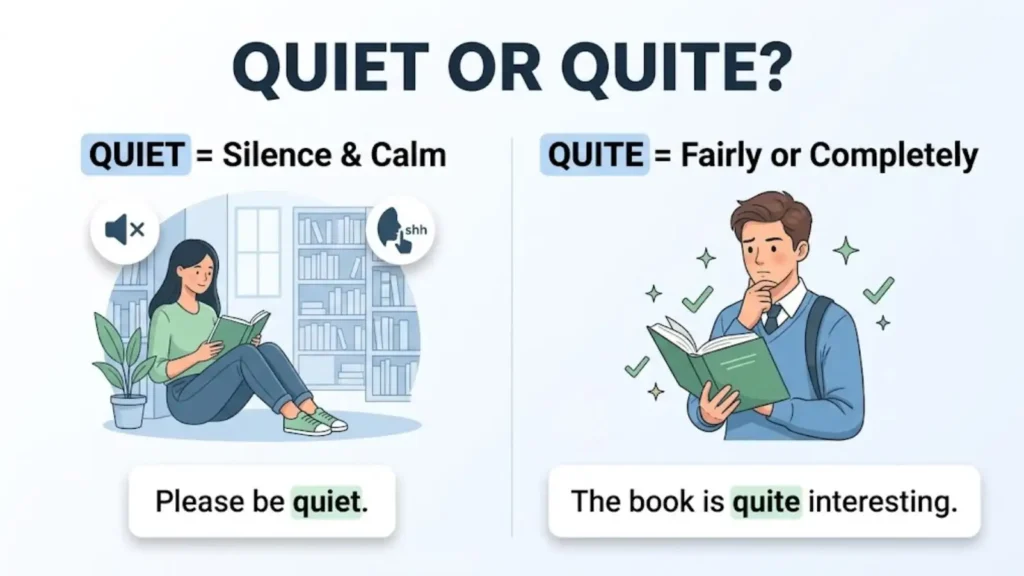
Have you ever stopped while writing because you were unsure whether to use quiet or quite? You are not alone. These two words look almost the same, but they have very different meanings. Using the wrong word can change the meaning of your sentence.
The good news is that learning the difference is easy. Quiet means making little or no noise. For example, “Please be quiet in the library.” On the other hand, quite means fairly, rather, or completely, depending on the sentence. For example, “The book is quite interesting.”
People often search for quiet or quite because the words have similar spellings and sounds. This can cause mistakes in schoolwork, emails, social media posts, and professional writing. English learners may also find these words confusing because their meanings are not related.
In this guide, you will learn the meaning of each word, its origin, and how to use it correctly. You will also see simple examples, common mistakes, and helpful tips. By the end, you will know which word fits your sentence.
Quiet or Quite – Quick Answer
Quiet means little or no noise. It can also describe a person or place that is calm.
Quite means fairly, rather, or completely. Its exact meaning depends on the context.
Examples of Quiet
- Please keep the room quiet.
- The library is very quiet.
- She is a quiet person.
Examples of Quite
- The test was quite easy.
- I am quite happy with my results.
- The movie was quite amazing.
Easy Memory Trick
Remember this simple rule:
- Quiet = silence or calm
- Quite = degree or amount
If you are talking about noise, use quiet. If you want to show how much or how strongly something is true, use quite.
The Origin of Quiet or Quite
The words quiet and quite have different histories. Although they look similar, they developed from different word forms.
The Origin of Quiet
The word quiet comes from Old French quiet and Latin quietus, meaning at rest or free from disturbance. Over time, English speakers began using it to describe places, people, and situations with little noise.
Today, quiet can describe a peaceful room, a calm person, or a period without much activity.
Examples:
- The house was quiet after dinner.
- We enjoyed a quiet afternoon.
- Please stay quiet during the lesson.
The Origin of Quite
The word quite comes through Old French from Latin quietus, which also meant at rest or free from disturbance. However, its meaning changed as it developed in English.
Today, quite is an adverb. It can mean fairly, rather, or completely. The meaning often depends on the adjective or phrase that follows it.
Examples:
- The meal was quite good.
- She was quite certain about her answer.
- The room was quite empty.
The words share a distant historical connection, but their modern meanings and uses are different.
British English vs American English Spelling
Both quiet and quite are correct in British and American English. Neither word has a different standard spelling in these varieties.
The main difference is pronunciation and, in some contexts, how strongly people use the word quite.
| Feature | American English | British English |
|---|---|---|
| Correct spelling for little noise | Quiet | Quiet |
| Correct spelling for degree | Quite | Quite |
| Part of speech: quiet | Adjective or verb | Adjective or verb |
| Part of speech: quite | Adverb | Adverb |
| Common meaning of quite | Fairly or completely | Fairly or completely |
| Example | The room is quiet. | The room is quiet. |
| Example | The film was quite good. | The film was quite good. |
Does Quite Mean the Same Thing in Both Countries?
Not always in terms of emphasis.
In American English, quite often means very or completely, though it can also mean fairly.
In British English, quite can mean fairly or moderately in some contexts. It can also mean completely, especially with words that suggest an absolute state.
For example:
- American English: “The meal was quite good” may suggest that it was very good.
- British English: “The meal was quite good” may suggest that it was fairly good.
These are tendencies, not strict rules. The speaker’s tone and the context also matter.
Which Spelling Should You Use?
You do not need to choose between British and American spelling for quiet or quite. Both words are correct in both varieties. Instead, choose the word that matches your meaning.
For American Readers
Use quiet when talking about silence or calm.
Example: “Please keep the classroom quiet.”
Use quite when showing degree or emphasis.
Example: “The lesson was quite helpful.”
For British and Commonwealth Readers
The same spelling rules apply.
Examples:
- “It is a quiet village.”
- “The village is quite beautiful.”
However, pay attention to context because quite can express different levels of emphasis.
For Global English Writers
If you write for an international audience, use simple sentences that make your meaning clear.
For example:
- “The room is quiet.”
- “The room is quite large.”
These sentences show the difference without relying on regional expressions.
For websites, school assignments, emails, and business documents, correct word choice matters more than choosing a national spelling style.
Common Mistakes with Quiet or Quite
Writers often confuse these words because they differ by only one letter. Here are the most common errors and how to fix them.
Mistake 1: Using Quite Instead of Quiet
Incorrect: Please be quite in the library.
Correct: Please be quiet in the library.
The sentence asks people to make little or no noise. Therefore, quiet is the correct word.
Mistake 2: Using Quiet Instead of Quite
Incorrect: The movie was quiet interesting.
Correct: The movie was quite interesting.
Here, quite describes the degree to which the movie was interesting.
Mistake 3: Thinking Quiet Always Describes a Person
Quiet can describe people, but it can also describe places, sounds, and situations.
Examples:
- a quiet child
- a quiet street
- a quiet evening
- a quiet voice
Mistake 4: Forgetting That Quite Is an Adverb
Quite often modifies adjectives and adverbs.
Examples:
- quite small
- quite quickly
- quite useful
- quite well
Quiet, by contrast, is commonly an adjective.
Example: “The children were quiet.”
Mistake 5: Assuming Quite Always Means Very
Quite does not always mean very. It may mean fairly, rather, or completely.
For example:
- “The film was quite good” can mean fairly good.
- “I am quite certain” can mean completely certain.
The context helps you understand the intended meaning.
Quiet or Quite in Everyday Examples
Both words appear in daily conversations, emails, news stories, social media, and formal writing. Learning these examples can help you use them with confidence.
In Emails
Quiet:
“Could you please keep the office quiet during the meeting?”
Quite:
“I am quite happy with the final report.”
In the first example, quiets refers to noise. The second, quite adds emphasis to happy.
In News Writing
Quiet:
“The town remained quiet after the storm.”
Quite:
“The new plan is quite different from the original proposal.”
News writers use quiet to describe a lack of noise or activity. They use quite to show degree or difference.
On Social Media
Quiet:
“I love spending a quiet evening at home.”
Quite:
“That new song is quite good!”
Both examples are natural. The first describes a peaceful evening, while the second expresses an opinion about a song.
In Formal Writing
Quiet:
“The study took place in a quiet room to reduce distractions.”
Quite:
“The results were quite clear.”
In formal writing, choose the word that expresses your intended meaning. Avoid using quite when a more precise word would make your sentence clearer.
Quiet or Quite – Comparison Table
| Feature | Quiet | Quite |
|---|---|---|
| Main meaning | Little or no noise | Fairly, rather, or completely |
| Part of speech | Usually an adjective | Adverb |
| Common use | Describes a person, place, or sound | Modifies an adjective, adverb, or phrase |
| Example | The baby is quiet. | The baby is quite happy. |
| Another example | We need a quiet place. | The place is quite large. |
| Opposite idea | Noisy or loud | Depends on the word or phrase |
| Memory clue | Silence | Degree or amount |
Quick Comparison
- The classroom is quiet. (It has little noise.)
- The classroom is quite large. (It is fairly or very large.)
- She is a quiet student. (She does not speak much or make much noise.)
- She is quite confident. (She has a high degree of confidence.)
Quiet or Quite – Google Trends and Usage Data
The phrase quiet or quite is a common English grammar search because the two words are easy to mix up. People often look for explanations when writing essays, completing schoolwork, editing articles, or learning English as a second language.
Search interest can vary across countries and over time. English-speaking countries such as the United States, the United Kingdom, Canada, and Australia have many writers and learners who use both words. People in other countries also search for grammar explanations to improve their English.
Google Trends can help compare search interest by country, region, and time period. However, it measures relative search interest rather than the total number of people who use a word. It also does not prove that one spelling is more correct than another.
There is no spelling contest between these words. Both are standard English words, and each has its own meaning.
For accurate writing, focus on the sentence rather than search popularity. Use quiet for silence or calm, and quite to express degree or emphasis.
FAQs About Quiet or Quite
1. What is the difference between quiet and quite?
Quiet means little or no noise. Quite means fairly, rather, or completely, depending on context.
Example: “The room is quiet.” “The room is quite large.”
2. Is it quite or quiet a place?
Use quiet when describing a place with little noise.
Correct: “This is a quiet place.”
You can also use quite before an adjective to describe the place.
Example: “This place is quite peaceful.”
3. Does quite mean very?
Sometimes. Quite can mean very or completely, but it can also mean fairly or rather. The intended meaning depends on the sentence and the variety of English.
4. Is quiet an adjective or an adverb?
Quiet is usually an adjective.
Example: “The room is quiet.”
The word quietly is the common adverb form.
Example: “She spoke quietly.”
5. Is quite an adjective?
No. Quite is an adverb. It often modifies adjectives and other adverbs.
Example: “The test was quite easy.”
6. Are quiet and quite pronounced the same way?
No. They have different vowel sounds. Quiet is usually pronounced like “KWY-uht,” while quite sounds like “KWYT.” Pronunciation can vary slightly by accent.
7. Which word should I use in an email?
Use quiet when asking for less noise or describing a peaceful setting. Use quite when expressing degree.
Examples:
- “Please keep the meeting room quiet.”
- “I am quite pleased with your work.”
Conclusion
Understanding quiet or quite is an easy way to improve your English writing. Although these words look similar, they have different meanings and grammatical roles.
Use quiet when you describe little noise, calm behavior, or a peaceful place. For example, “The library is quiet.” Use quite when you want to express degree or emphasis. For example, “The library is quite large.”
Remember that both words have the same standard spelling in British and American English. The main difference is how they are used in a sentence. Also, quite can mean fairly or completely, so the context matters.
When you are unsure, read your sentence again and ask what you want to say. Are you talking about noise or calm? Choose quiets. Are you describing how much or how strongly something is true? Choose quite.
With a little practice, you can avoid these common mistakes in emails, essays, articles, and everyday conversations. Keep the simple rule in mind: quiet means calm, while quite means degree. This will help you write more clearly and confidently.