
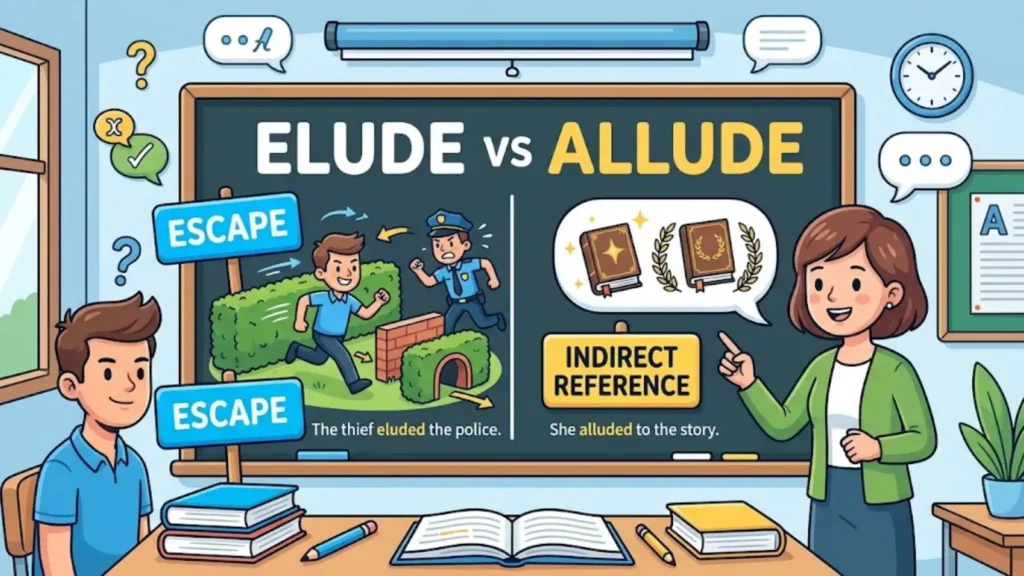
Elude vs allude is a common English word comparison that confuses many writers. Both words sound similar, but they have completely different meanings. Using the wrong word can change the message you want to share.
Imagine a police officer chasing a clever thief. The thief manages to escape capture. In this situation, you can say the thief eluded the police. Now imagine a speaker discussing a famous movie without naming it directly. The speaker alludes to the movie instead.
Although these words look and sound alike, they describe different actions. Elude means to escape, avoid, or remain difficult to understand. Allude means to refer to something indirectly, often without naming it.
Understanding the difference between elude and allude can improve your writing, conversations, and professional communication. You will also find it easier to recognize these words in books, news articles, emails, and everyday discussions.
This guide explains their meanings, origins, grammatical uses, and common mistakes. It also provides simple examples to help you choose the correct word confidently.
Table of Contents
- Elude vs Allude: Quick Answer
- What Does Elude Mean?
- What Does Allude Mean?
- Origin and History of Both Words
- British English vs American English
- Which Word Should You Use?
- Common Mistakes
- Everyday Examples
- Usage Trends and Popularity
- Elude vs Allude Comparison Table
- Special Rules and Important Uses
- Frequently Asked Questions
- Conclusion
Elude vs Allude: Quick Answer
Elude means to escape, avoid, or remain beyond someone’s reach or understanding. Allude means to mention or refer to something indirectly.
Example:
- Elude: The suspect eluded the police during the chase.
- Allude: The teacher alluded to an important exam without announcing its date.
Remember this simple rule: You elude something you escape, but you allude to something you mention indirectly.
What Does Elude Mean?
Elude is a verb that means to escape from someone or something, avoid capture, or remain difficult to understand or achieve.
People commonly use this word when someone avoids being caught. However, it also describes ideas, answers, and solutions that remain difficult to find.
Examples of Elude in Sentences
- The criminal managed to elude the police.
- The answer continued to elude the student.
- Sleep often eludes me before an important interview.
- The team tried to elude its opponents during the match.
- Despite several attempts, the scientist could not find a solution that had eluded researchers for years.
In these examples, something escapes, avoids, or remains beyond someone’s reach.
Different Uses of Elude
1. To escape capture
A person or animal can elude someone trying to catch them.
Example: The fox eluded the hunters by hiding in the forest.
2. To avoid detection
Someone can elude attention, suspicion, or security measures.
Example: The thief eluded detection for several months.
3. To remain difficult to understand
An idea, answer, or meaning can elude someone’s understanding.
Example: The meaning of the poem eluded me.
4. To remain difficult to achieve
A goal or success can elude someone despite repeated efforts.
Example: Victory eluded the team during the final match.
Notice that elude does not always involve physical escape. It can also describe something that remains difficult to grasp mentally or achieve in practice.
What Does Allude Mean?
Allude is a verb that means to refer to something indirectly without mentioning it clearly or directly.
Writers, speakers, teachers, and public figures often allude to events, people, books, or ideas. They may expect their audience to understand the reference without receiving a complete explanation.
Examples of Allude in Sentences
- The politician alluded to recent financial problems.
- She alluded to their disagreement but did not explain it.
- The author alludes to Shakespeare in the final chapter.
- During dinner, he alluded to a surprise without revealing its details.
- The manager alluded to possible changes in the company.
Each example involves an indirect reference rather than an escape.
Different Uses of Allude
1. To refer indirectly
Example: The speaker alluded to the incident without naming anyone involved.
2. To suggest something without stating it openly
Example: Her smile alluded to a secret she was keeping.
3. To make a literary or cultural reference
Example: The novel alludes to an ancient Greek myth.
4. To hint at a subject during conversation
Example: My friend alluded to a new job but shared no details.
Does Allude Need the Word “To”?
Yes. In standard English, allude to is the usual construction when identifying the subject of an indirect reference.
Correct: The writer alluded to the historical event.
Incorrect: The writer alluded the historical event.
This small grammatical rule helps distinguish allude from elude. The word elude does not normally require to before its direct object.
Origin and History of Elude vs Allude
Although elude and allude have similar spellings, their histories help explain their different meanings.
Origin of Elude
The word elude comes from the Latin verb eludere, meaning to evade, escape, or avoid. It combines a prefix meaning “out” or “away” with a verb associated with playing or avoiding.
Over time, elude developed the familiar meanings of escaping capture, avoiding something, or remaining difficult to understand.
For example, the phrase “the answer eluded me” suggests that the answer remained beyond the speaker’s grasp.
Origin of Allude
The word allude comes from the Latin alludere, meaning to play with, refer to, or make an indirect reference. Its historical roots connect it with the idea of hinting at something.
Today, allude commonly describes indirect references in speech and writing.
For example, a writer might allude to a famous story without naming its title.
Why Do People Confuse These Words?
Elude and allude share several features:
- Both are verbs.
- Both contain six letters.
- Both have similar spellings.
- Both can appear in formal writing.
- Both begin with the letter “a” or an “e” sound, depending on pronunciation.
However, their meanings and grammatical patterns differ. Learning each word through examples is more effective than relying on spelling alone.
British English vs American English
There is no major difference between British and American English in the meanings of elude and allude. Both varieties use the words in the same general ways.
| Feature | American English | British English |
|---|---|---|
| Elude meaning | Escape or remain beyond reach | Escape or remain beyond reach |
| Allude meaning | Refer indirectly | Refer indirectly |
| Elude example | The suspect eluded police. | The suspect eluded the police. |
| Allude example | She alluded to the problem. | She alluded to the problem. |
| Main distinction | Escape versus indirect reference | Escape versus indirect reference |
The article usage in the police example can vary with context and regional style. The underlying meaning of elude does not change.
Both spellings are standard in the United States and the United Kingdom. Therefore, you do not need to choose a regional spelling when using these words.
Which Word Should You Use?
Choosing between elude and allude becomes easy when you focus on the intended meaning.
Use Elude When Something Escapes or Remains Out of Reach
Choose elude when describing:
- A person escaping capture.
- Someone avoiding detection.
- An answer that remains difficult to find.
- A concept that is difficult to understand.
- A goal that someone has not achieved.
Examples:
- The suspect eluded the officers.
- The solution eluded the researchers.
- Peace continued to elude the troubled region.
Use Allude When Someone Makes an Indirect Reference
Choose allude when describing:
- A hint about a subject.
- An indirect reference to an event.
- A literary or historical reference.
- A suggestion that avoids naming something directly.
Examples:
- The speaker alluded to the recent controversy.
- The author alluded to a famous poem.
- She alluded to her plans for the weekend.
An Easy Memory Trick
Think of elude as escape. Both words begin with different letters, but the association helps you remember their meanings.
For allude, remember the common phrase allude to. If someone alludes to a topic, they refer to it indirectly.
Try asking yourself two questions:
- Is someone or something escaping, avoiding, or remaining beyond reach? Use elude.
- Is someone referring to something without stating it directly? Use allude.
These questions will help you select the right word in most situations.
Common Mistakes When Using Elude and Allude
Even experienced writers sometimes mix up these words. Fortunately, a few simple corrections can prevent most errors.
Mistake 1: Using Elude for an Indirect Reference
Incorrect: The author eluded to a famous historical event.
Correct: The author alluded to a famous historical event.
Why? The author refers to the event indirectly rather than escaping it.
Mistake 2: Using Allude for Escaping Capture
Incorrect: The criminal alluded the police during the chase.
Correct: The criminal eluded the police during the chase.
Why? The criminal avoided capture. No indirect reference occurred.
Mistake 3: Forgetting “To” After Allude
Incorrect: She alluded the disagreement during the meeting.
Correct: She alluded to the disagreement during the meeting.
Why? The standard expression is “allude to something.”
Mistake 4: Confusing Allude With Directly Mention
Incorrect: He alluded the problem clearly and explained every detail.
Better: He mentioned the problem clearly and explained every detail.
Why? Allude usually describes an indirect reference. If someone states something openly, mention, explain, or discuss may be more appropriate.
Everyday Examples of Elude vs Allude
Understanding these words becomes easier when you see them in everyday situations.
1. Emails
Elude: The reason for the unexpected error continues to elude our technical team.
Allude: In my previous email, I alluded to a possible change in the schedule.
The first sentence describes a problem that remains unresolved. The second refers indirectly to an earlier topic.
2. Social Media
Elude: The celebrity managed to elude photographers while leaving the hotel.
Allude: Her latest post alluded to a new project without revealing its name.
3. News Reports
Elude: Investigators searched for the suspect, who had eluded authorities for weeks.
Allude: The minister alluded to upcoming policy changes during the press conference.
4. Classroom
Elude: The final mathematics question continued to elude several students.
Allude: The teacher alluded to a surprise quiz scheduled for the following week.
5. Daily Life
Elude: The name of my favorite childhood teacher always eludes me.
Allude: My brother alluded to a birthday surprise but refused to explain it.
6. Books and Literature
Elude: The deeper meaning of the novel eluded me on my first reading.
Allude: The novelist alluded to Greek mythology throughout the story.
These examples show why context matters. Elude describes something that escapes someone’s reach, while allude describes an indirect reference.
Usage Trends and Popularity
Both words remain part of standard modern English. However, their meanings suit different situations, so they are not interchangeable alternatives.
Elude frequently appears in discussions about crime, sports, memory, achievement, and difficult problems. For example, a suspect may elude capture, a championship may elude a team, or a forgotten name may elude someone’s memory.
Allude often appears in literature, political reporting, criticism, formal discussions, and everyday conversations involving hints or indirect references. Writers may allude to historical events, famous people, cultural traditions, or earlier statements.
Which Word Is More Common?
Their relative frequency can vary by publication, topic, and context. Without a specific, comparable corpus or search-trend dataset, it would be misleading to claim an exact popularity ranking.
For practical writing, focus on meaning rather than frequency. Choose the word that accurately describes the action.
Elude vs Allude Comparison Table
| Feature | Elude | Allude |
|---|---|---|
| Part of speech | Verb | Verb |
| Main meaning | Escape or avoid | Refer indirectly |
| Common phrase | Elude capture | Allude to something |
| Typical object | Police, danger, an answer, success | A person, event, idea, or text |
| Related word | Elusive | Allusion |
| Example | The answer eluded me. | She alluded to the answer. |
| Memory trick | Think “escape” | Think “indirect reference” |
Remember that allude to is the usual grammatical construction, while elude can take a direct object.
Special Rules and Important Uses
Rule 1: Elude Can Describe Mental Difficulties
Elude does not always involve someone physically escaping.
For example:
- His name eludes me.
- The meaning of the instructions eluded the students.
- A clear explanation eluded the researchers.
In each case, something remains difficult to remember, understand, or discover.
Rule 2: Allude Does Not Mean Explain Fully
When someone alludes to a subject, they usually leave some information unstated.
For example:
“She alluded to the disagreement.”
This sentence suggests that she hinted at the disagreement without discussing every detail.
If she explained the disagreement openly, you could instead say, “She discussed the disagreement.”
Rule 3: Learn the Related Nouns
The related nouns provide another useful distinction.
- Elude → elusive: difficult to catch, find, achieve, or understand.
- Allude → allusion: an indirect reference to something.
Examples:
“The solution remains elusive.”
“The poem contains an allusion to Greek mythology.”
Be careful not to confuse allusion with illusion. An allusion is an indirect reference, while an illusion is something that creates a false or misleading impression.
Rule 4: Check the Sentence’s Purpose
Before choosing a word, identify what the sentence describes.
If the sentence concerns escaping, avoiding, remembering, or achieving something, elude is usually appropriate.
If the sentence concerns hinting at a subject or referring to something indirectly, allude is the better choice.
Frequently Asked Questions
Q1. What is the main difference between elude and allude?
Elude means to escape, avoid, or remain difficult to understand. Allude means to refer to something indirectly. For example, a suspect can elude police, while a speaker can allude to a recent event.
Q2. Is it allude to or elude to?
Use allude to when referring indirectly to a subject. For example, “She alluded to the earlier conversation.” Elude usually takes a direct object, as in “She eluded the reporters.”
Q3. Can elude mean difficult to understand?
Yes. Elude can describe something that remains difficult to understand, remember, or achieve. For example, “The meaning of the poem eluded me” means that the poem’s meaning was difficult for me to understand.
Q4. What is an example of allude in a sentence?
“The manager alluded to possible changes during the meeting.” This means the manager hinted at the changes without explaining them directly.
Q5. What is the noun form of allude?
The noun form is allusion. It describes an indirect reference to a person, event, work of literature, or another subject. For example, the novel contains an allusion to Shakespeare.
Q6. What is the adjective form of elude?
The related adjective is elusive, meaning difficult to find, catch, understand, or achieve. For example, “The team continued searching for the elusive answer.”
Q7. Are elude and allude pronounced the same way?
No. They have different initial vowel sounds in standard English pronunciation. Elude begins with an “ee” sound, while allude begins with a short “uh” sound in common English pronunciations. Their similar spelling can still make them confusing in writing.
Conclusion
The difference between elude vs allude comes down to two simple ideas: escape and reference.
Use elude when someone avoids capture, something remains difficult to understand, or a goal stays out of reach. Use allude when someone hints at a subject or refers to it indirectly.
For example, a suspect may elude the police, while a journalist may allude to the investigation without revealing every detail.
Remember the phrase “allude to” as a useful grammatical clue. When you are unsure, ask yourself whether the sentence describes an escape or an indirect reference.
With a little practice, you can use both words accurately in essays, emails, conversations, and professional writing.