
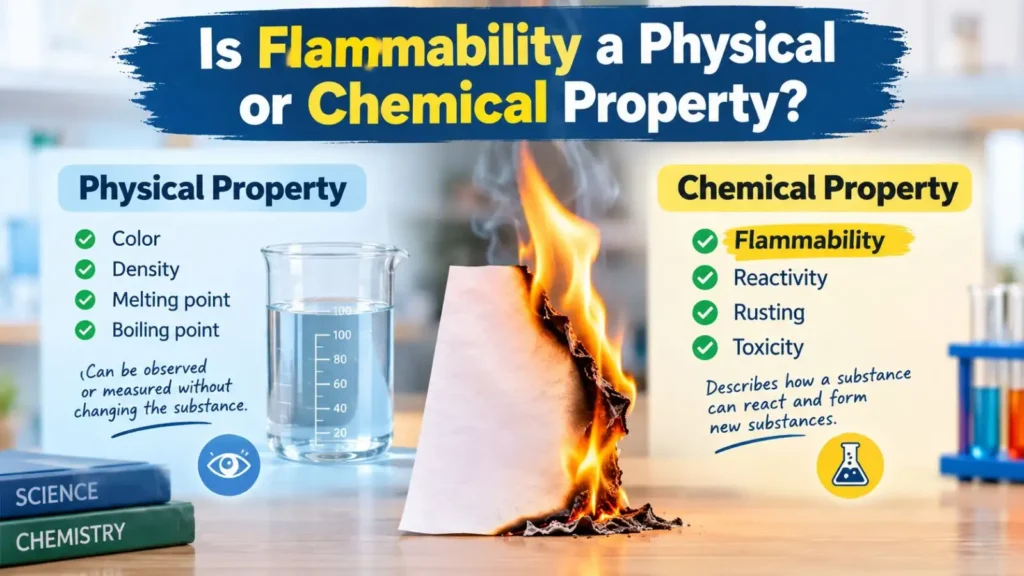
Have you ever wondered why paper burns, wood catches fire, or gasoline ignites so quickly? These examples help explain an important science question: is flammability a physical or chemical property?
The answer is simple, but many students mix up physical and chemical properties. Both describe matter, yet they tell us different things. A physical property can be seen or measured without changing a substance into something new. A chemical property explains how a substance can react and form new substances.
Flammability tells us whether a material can catch fire and burn. When paper burns, it reacts with oxygen and forms new substances, such as gases and ash. Therefore, flammability is a chemical property, not a physical property.
People often search for this question when studying chemistry, preparing for school tests, or completing science homework. They may also confuse flammability with other properties, such as color, mass, density, or melting point.
Is Flammability a Physical or Chemical Property – Quick Answer
Correct answer: Flammability is a chemical property.
It describes a material’s ability to burn and react with oxygen.
Incorrect answer: Flammability is a physical property.
Burning causes a chemical reaction that forms new substances.
Simple Examples
- ✓ Paper is flammable: It can burn and form new substances.
- ✓ Wood is flammable: It reacts with oxygen when it burns.
- ✓ Gasoline is flammable: It can ignite and burn under suitable conditions.
- ✗ Flammability is the same as color: Color can be observed without burning the material.
- ✗ Flammability is the same as melting point: Melting point describes a physical change, not the ability to burn.
Remember: If a property tells you how a substance can react chemically, it is a chemical property.
The Origin of “Flammability”
The word flammability comes from flammable, which means capable of catching fire and burning. The word is linked to the Latin word * flamma*, meaning “flame.”
The ending -ity turns the word into a noun. It names the quality or condition of being flammable.
For example:
- Flammable: Paper is flammable.
- Flammability: Paper has a high ability to catch fire under suitable conditions.
- Inflammable: This also means capable of catching fire. It does not mean fireproof.
Why Does the Word Cause Confusion?
The word inflammable can confuse readers because the prefix in- often means “not” in English. However, in this word, it does not mean that a material cannot burn.
Use nonflammable when you mean a material that does not easily catch fire under specified conditions. Even then, check the material’s actual safety rating before treating it as fireproof.
There is no standard British-versus-American spelling difference in flammability. Both varieties use the same spelling.
British English vs American English Spelling
The word flammability is spelled the same way in British and American English. Unlike words such as colour and color, it does not change between these varieties.
| Word or phrase | British English | American English |
|---|---|---|
| Flammability | ✓ Flammability | ✓ Flammability |
| Flammable | ✓ Flammable | ✓ Flammable |
| Nonflammable | ✓ Nonflammable | ✓ Nonflammable |
| Inflammable | ✓ Inflammable | ✓ Inflammable |
| Colour / Color | ✓ Colour | ✓ Color |
Is “Flammability” Spelled Correctly?
- ✓ Flammability is a chemical property. Correct spelling and scientific use.
- ✓ The flammability of gasoline is high. Correct spelling and use.
- ✗ Flamability is a chemical property. Incorrect spelling; it needs two m’s.
- ✗ Flamability is a physical property. Incorrect spelling and incorrect scientific classification.
Writing tip: Always spell the word with two m’s: flammability.
Which Spelling Should You Use?
Since flammability has one standard spelling in both major varieties of English, you do not need to choose between British and American versions.
- For US readers: Use flammability in schoolwork, lab reports, and science articles.
- For UK and Commonwealth readers: Use flammability in the same contexts.
- For a global audience: Use flammability and explain its meaning in simple terms.
If you write for a science website, choose one English style and keep it consistent throughout the article. For example, you may use color for a US audience or colour for a UK audience, but the word flammability stays unchanged.
Professional Writing Examples
- ✓ “Flammability is a chemical property of matter.”
- ✓ “The report examines the flammability of common household materials.”
- ✗ “Flamability is a physical property of matter.”
- ✗ “The material’s flamability was tested in the lab.”
The correct spelling is always flammability.
Common Mistakes with “Is Flammability a Physical or Chemical Property?”
Students often confuse properties that describe a substance with changes that happen to it. These simple corrections can help.
| Statement | Correct or incorrect? | Explanation |
|---|---|---|
| Flammability is a chemical property. | ✓ Correct | It describes the ability to burn through a chemical reaction. |
| Flammability is a physical property. | ✗ Incorrect | Burning changes the chemical composition of a substance. |
| Density is a physical property. | ✓ Correct | Density can be measured without changing the substance into something new. |
| Burning paper is a physical change. | ✗ Incorrect | Burning produces new substances. |
| Melting ice is a physical change. | ✓ Correct | Water remains water when ice melts. |
| Inflammable means unable to burn. | ✗ Incorrect | Inflammable means capable of catching fire. |
Mistake 1: Confusing Flammability with Appearance
Color, shape, and texture are physical properties. You can observe these properties without burning the material.
Flammability is different because it describes how a material behaves during a chemical reaction.
Mistake 2: Thinking Every Change Is Physical
Some changes only affect a material’s form. For example, cutting paper changes its size, not its chemical identity.
However, burning paper produces new substances. Therefore, burning is a chemical change.
Mistake 3: Confusing Flammability with Ignition Temperature
Flammability describes the ability of a substance to catch fire and burn. Ignition temperature relates to the temperature at which ignition occurs under specified conditions.
These terms are related, but they do not mean the same thing.
Mistake 4: Treating “Nonflammable” as Completely Risk-Free
A nonflammable material may resist burning under certain test conditions. However, that does not mean every product made from it is safe in every fire situation. Always follow its safety instructions.
Flammability in Everyday Examples
Flammability appears in daily life, science classes, workplace safety, and product labels. Understanding the term helps people recognize fire risks.
1. In Emails
Professional emails often use the word when discussing storage, safety, or laboratory work.
Example:
“Please check the flammability information before storing these chemicals.”
✓ Correct: The sentence uses flammability to describe a fire-related chemical property.
✗ Incorrect: “Please check the flamability information.”
The incorrect version leaves out one m.
2. In News Reports
News reports may discuss flammability after a fire, an industrial accident, or a product safety warning.
Example:
“The investigation examined the flammability of materials stored inside the building.”
✓ Correct: The sentence describes the materials’ ability to burn.
✗ Incorrect: “The investigation proved that flammability is a physical property.”
That claim is scientifically wrong.
3. On Social Media
Short science posts can explain the concept in simple language.
Example:
“Quick science fact: Flammability is a chemical property because burning can create new substances. ✓”
A good educational post gives a clear answer and a short reason.
4. In Formal Writing
Students and scientists use the word in lab reports, textbooks, and research documents.
Example:
“The flammability of the sample was evaluated under controlled laboratory conditions.”
✓ Correct: The statement uses a formal, scientific tone.
✗ Incorrect: “The sample’s flammability was measured as its color.”
Color and flammability describe different properties.
5. In Everyday Life
Paper
✓ Paper can burn, so flammability is a chemical property of paper.
Wood
✓ Wood reacts during burning, forming new substances.
Water
✓ Water’s freezing point is a physical property. Water itself does not burn under ordinary conditions.
Never test flammability at home by setting unknown materials on fire. Use approved laboratory procedures and safety guidance.
Is Flammability a Physical or Chemical Property – Google Trends and Usage Data
People search for this question in educational and scientific contexts. It is especially relevant to students learning about physical properties, chemical properties, and changes in matter.
However, the spelling of flammability does not differ between British and American English. The main difference in search interest is likely to come from the wording of queries, educational needs, and local search habits.
Common Search Phrases
| Search phrase | Main intent |
|---|---|
| Is flammability a physical or chemical property? | ✓ Find the direct science answer |
| Flammability chemical property | ✓ Understand the classification |
| Examples of chemical properties | ✓ Learn related concepts |
| Physical vs chemical properties | ✓ Compare the two categories |
| Is flammability a physical property? | ✓ Check a possible misconception |
What About Country-by-Country Popularity?
Google Trends can compare search interest by country, region, and time. However, its scores are normalized from 0 to 100, rather than showing exact search counts.
Without a verified Trends comparison for the selected phrases, dates, and countries, it would be misleading to claim that one country searches for this term more than another.
For accurate research, compare the exact phrase across the United States, United Kingdom, Canada, and Australia over the same period. Also compare broader terms such as chemical properties to understand the topic’s wider interest.
Key takeaway: Search popularity is separate from scientific accuracy. Regardless of where the question is searched, flammability is a chemical property.
Comparison Table: Physical vs Chemical Properties
This table shows how flammability differs from other common properties of matter.
| Property | Type | Example |
|---|---|---|
| Flammability | Chemical | ✓ Paper can burn. |
| Rusting ability | Chemical | ✓ Iron can react with oxygen and moisture. |
| Reactivity with acid | Chemical | ✓ Some metals react with acids. |
| Color | Physical | ✓ Gold has a yellow color. |
| Density | Physical | ✓ Density can be measured without a chemical change. |
| Melting point | Physical | ✓ Ice melts into liquid water. |
| Boiling point | Physical | ✓ Water boils under suitable conditions. |
| Solubility | Physical | ✓ Sugar dissolves in water without becoming a new substance. |
Easy rule: A chemical property describes how a substance can react. A physical property can be observed or measured without changing its chemical identity.
Frequently Asked Questions (FAQs)
1. Is flammability a physical or chemical property?
Flammability is a chemical property. It describes a substance’s ability to burn through a chemical reaction.
2. Why is flammability a chemical property?
Burning involves a chemical reaction. For example, paper reacts with oxygen and forms new substances. This shows that flammability is a chemical property.
3. Is flammability an intensive or extensive property?
Flammability is generally classified as an intensive property because it does not depend simply on the amount of material. However, actual burning behavior can also depend on factors such as surface area, oxygen supply, and temperature.
4. Is burning a physical or chemical change?
Burning is a chemical change because it produces new substances. For example, burning wood produces gases, smoke, and other residues.
5. Is melting a physical or chemical property?
Melting point is a physical property. When ice melts, solid water becomes liquid water without changing its chemical identity.
6. Is flammability the same as ignition temperature?
No. Flammability describes the ability to catch fire and burn. Ignition temperature describes a temperature associated with ignition under specified conditions.
7. Is inflammability the opposite of flammability?
No. Inflammability also means the ability to catch fire. The word does not mean resistance to fire. The term nonflammable is used for materials that do not readily ignite under specified conditions.
Conclusion
Flammability is a chemical property, not a physical property. It describes a material’s ability to catch fire and burn through a chemical reaction. When paper, wood, or gasoline burns, the material reacts and produces new substances.
Physical properties are different. Color, density, melting point, and boiling point can be observed or measured without changing a substance’s chemical identity. Therefore, understanding the difference between physical and chemical properties makes chemistry easier to learn.
Remember these simple rules: ✓ Flammability is a chemical property. ✓ Burning is a chemical change. ✓ Melting ice is a physical change. ✗ Flammability is not a physical property.
The word flammability also has the same spelling in British and American English. You do not need to choose between two spelling variations. Whether you are writing homework, preparing a science report, or creating educational content, use the correct spelling and explain the science clearly.
Most importantly, never confuse inflammable with nonflammable. They have different meanings, and this difference matters for fire safety. With these facts in mind, you can confidently answer the question, “Is flammability a physical or chemical property?”
