
ince both words refer to distance and advancement, many English language learners and native speakers find it difficult to distinguish between farther and further. Despite their frequent interchangeability, there are certain minor distinctions that can enhance your writing’s intelligibility. You may communicate more clearly in essays, business emails, blogs, and casual interactions if you know when to use farther and when to choose further.
In clear terms, this guide covers the definitions, origins, typical errors, and useful examples of farther vs. further. By the conclusion, you will understand which term best describes physical distance and which is more appropriate for metaphorical concepts or further details.
|SEE ALSO: Traveler or traveller
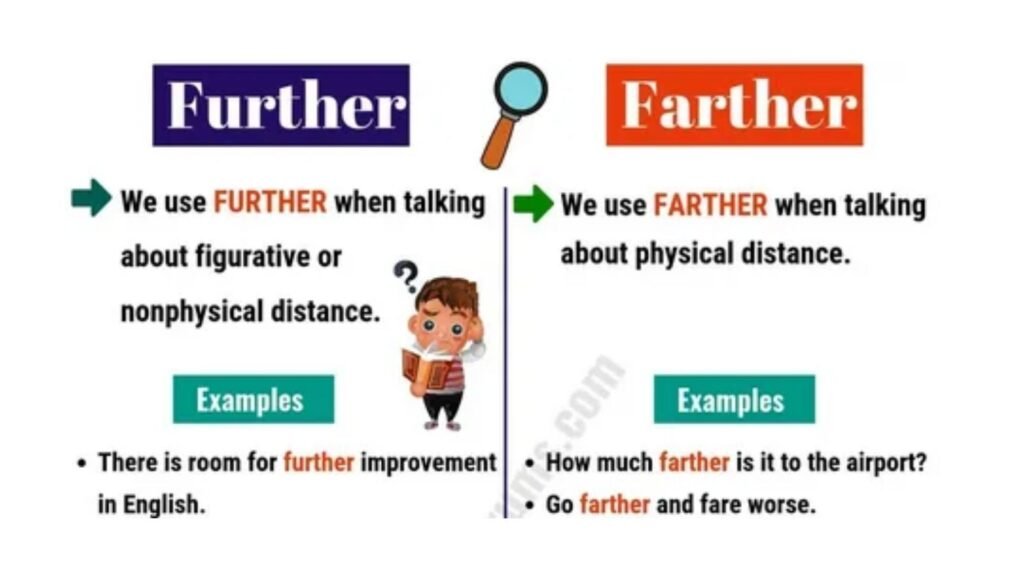
Farther vs Further – Quick Answer
The traditional rule is simple:
- Farther refers to physical distance.
- Further refers to figurative distance, additional information, or advancement.
Examples
- We walked farther down the trail.
- For further details, contact customer support.
In modern English, many writers use further for both meanings, but following the traditional distinction improves clarity.
Meaning of Farther vs Further
What Does “Farther” Mean?
Farther describes measurable physical distance.
Examples:
- The hotel is farther from the airport than I expected.
- She threw the ball farther than anyone else.
What Does “Further” Mean?
Further usually means additional, more advanced, or to a greater degree.
Examples:
- We need further research before making a decision.
- Please explain your idea further.
It can also describe figurative progress:
- His education helped him go further in life.
Why People Misspell or Confuse Farther vs Further
Many people confuse these words because they:
- Sound very similar.
- Share related meanings.
- Are sometimes used interchangeably by modern speakers.
- Appear in similar contexts.
Unlike spelling issues involving double letters such as address or success, this confusion comes from choosing the correct word rather than spelling it incorrectly.
|SEE LEARN MORE: Practice or practise
Memory Tip
- Farther = Far = Physical distance
- Further = Further discussion or additional information
Origin of Farther vs Further
Both words evolved from Old English and Germanic roots connected to the concept of distance.
- Farther developed as a comparative form closely linked with measurable physical distance.
- Further evolved from historical forms meaning “to advance” or “to promote,” giving it broader figurative uses.
Over time, dictionaries accepted overlapping meanings, although many editors still recommend the traditional distinction.
Common Examples
| Situation | Correct Word | Example |
|---|---|---|
| Physical distance | Farther | We drove farther north. |
| Extra information | Further | Please provide further evidence. |
| Career progress | Further | She wants to further her education. |
| Walking distance | Farther | The campsite is farther away. |
Everyday Usage
Please contact me for further information.
School
The museum is farther than our classroom.
Business
We need further approval before launching.
Travel
The next gas station is much farther down the highway.
Common Mistakes
❌ We walked further down the road. (Acceptable in modern English but traditionally less precise.)
✅ We walked farther down the road.
❌ The report needs farther analysis.
✅ The report needs further analysis.
Summary
Knowing farther versus further improves the clarity and professionalism of your writing. For quantifiable physical distance, use farther; for more details, progression, or symbolic progress, use further.
Following the classical distinction shows good grammar abilities and enhances precision, even though current English frequently accepts more in both contexts.
People also ask
- Why do Americans say farther, not further?
Many Americans traditionally use farther for physical distance and further for figurative or additional meanings, though further is also widely accepted. - Is it “money goes further” or “money goes farther”?
The correct phrase is “money goes further” because it refers to greater value or effectiveness, not physical distance. - Is it “walked further” or “farther”?
Traditionally, “walked farther” is preferred for physical distance, although “walked further” is also common in modern English. - Is it further or farther in British English?
In British English, further is often used for both physical and figurative meanings, while farther is less common but still correct for physical distance.