
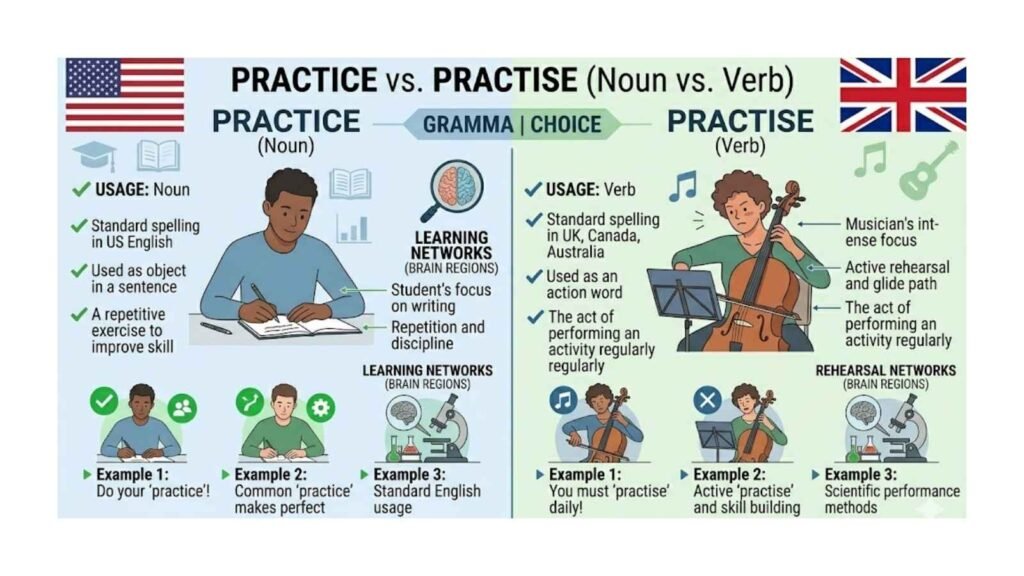
Understanding practice or practise helps writers avoid common spelling mistakes and improve communication. Many learners struggle because British and American English follow different conventions. Learning English grammar, spelling differences, verb and noun forms, British English, and American English makes your writing clearer and more professional.
Whether you write emails, academic papers, or blog posts, knowing when to use practice or practise ensures accuracy and builds confidence in every sentence.
|See also: Fistulagram or fistulogram
What Do “Practice” and “Practise” Mean?
Although the words share the same pronunciation, they serve different grammatical roles depending on the variety of English.
Practice
In British English, practice is primarily a noun. It refers to repeated activity, a habit, or a professional occupation.
Examples:
- Daily practice improves your piano skills.
- The doctor opened a new medical practice.
- Good writing requires regular practice.
In American English, practice functions as both the noun and the verb.
Practise
In British English, practise is the verb, meaning to perform repeatedly in order to improve a skill.
Examples:
- I practise the violin every evening.
- Athletes practise before every competition.
- She wants to practise public speaking.
American English generally replaces practise with practice, even when used as a verb.
British English vs American English Spelling
Regional spelling rules explain most of the confusion surrounding practice or practise.
| Usage | British English | American English |
|---|---|---|
| Noun | Practice | Practice |
| Verb | Practise | Practice |
| Example | I need more practice. | I need more practice. |
| Example | I practise every day. | I practice every day. |
Therefore, British English distinguishes between the noun and verb, while American English uses one spelling for both.
|SEE LEARN MORE: Choose or chose
Why Does This Spelling Difference Exist?
The distinction developed through historical changes in English influenced by French and Latin. British English preserved separate noun and verb spellings for several words ending in -ce and -se, while American English gradually simplified many of these differences.
As a result, British writers commonly distinguish between practice and practise, whereas Americans generally use practice in every context.
How Spell Checkers Depend on Language Settings
Many writers become confused because spell checkers automatically follow the language selected in their software.
Example:
- If your document uses American English, the spell checker may flag practise as incorrect.
- If your document uses British English, it may suggest practise as the proper verb spelling.
Before editing an article or academic paper, verify your language settings to avoid unnecessary corrections.
Similar -ise vs -ize Examples
The practice or practise distinction resembles other spelling variations found between British and American English.
| British English | American English |
|---|---|
| organise | organize |
| realise | realize |
| recognise | recognize |
| apologise | apologize |
Unlike these examples, however, practice/practise changes according to grammatical function in British English rather than simply regional preference.
Why Choosing the Correct Spelling Matters
Using the correct spelling demonstrates attention to detail and strengthens your credibility.
Professionals, students, journalists, and businesses should match their audience’s preferred variety of English. Consistent spelling improves readability, supports brand identity, and reduces distractions for readers.
Example:
- A UK university website should write: Students practise clinical skills through supervised practice.
- A US university website would naturally write: Students practice clinical skills through supervised practice.
Consistency makes your content appear polished and trustworthy.
Common Mistakes
Here are several mistakes people frequently make.
❌ I practise law in New York.
✅ I practice law in New York. (American English)
You need more practise before the exam.❌
You need more practice before the exam.✅
❌ She practices every morning. (British style guide)
✅ She practises every morning.
Always consider both grammar and regional style.
Tips to Remember the Difference
If you use British English:
- Practice = Noun
- Practise = Verb
Think of advice and advise, where the noun ends in -ce and the verb ends in -se.
If you write in American English:
- Simply use practice for both noun and verb forms.
Frequently Asked Questions
- When should I use practise vs practice?
In British English, use practice as a noun and practise as a verb. In American English, use practice for both. - Does a doctor practice or practise?
A doctor practices medicine in American English, while a doctor practises medicine in British English. - Is it piano practice or practise?
Piano practice is correct because it refers to the activity (a noun). Example: “Daily piano practice improves your skills.” - What does “practise” mean?
Practise is a British English verb that means to perform an activity repeatedly to improve a skill or ability.
Conclusion
In conclusion, mastering practice or practise strengthens correct English usage, grammar rules, writing consistency, British vs American spelling, and professional communication.
By understanding regional differences and grammatical roles, you can choose the right form with confidence, avoid common errors, and produce polished content that readers and editors appreciate.