
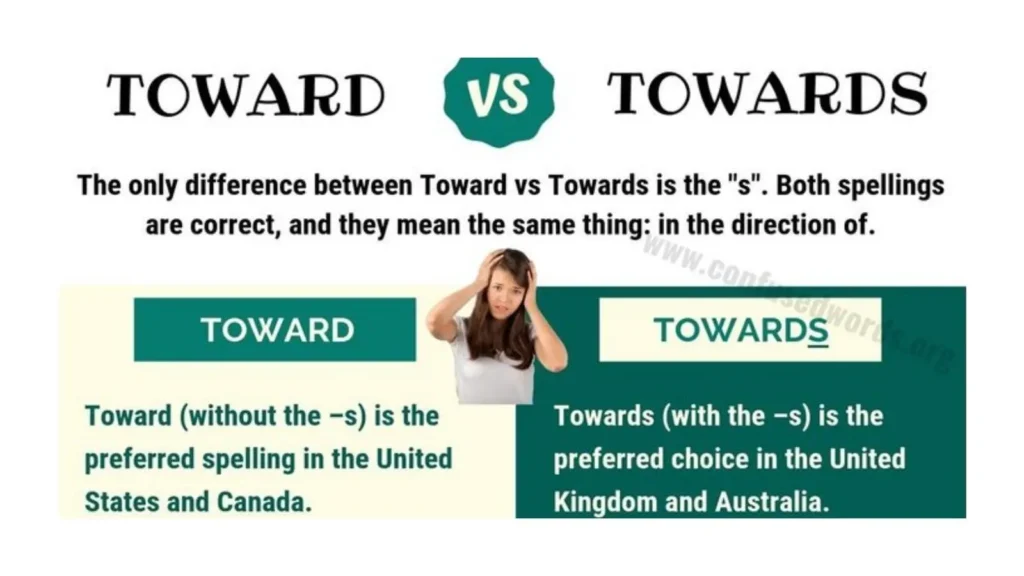
Many writers wonder whether towards or toward is the correct spelling. This common grammar rule question appears because both forms are accepted in English. The difference mainly depends on British English and American English preferences rather than meaning.
Understanding these spelling differences helps improve word usage, writing accuracy, and communication skills.
Whether you are creating content, writing emails, or preparing professional documents, learning the correct English writing style ensures consistency and confidence in every sentence.
|See more: Sergeant or sargent
Towards or Toward – Quick Answer
Both towards and toward mean “in the direction of” or “closer to something.”
Examples:
- She walked towards the door.
- She walked toward the door.
Both sentences are correct and have the same meaning.
The Origin of Towards or Toward
The word comes from the Old English term toweard, which meant “in the direction of” or “approaching.”
Over time, English developed regional spelling preferences. British English commonly added the letter s to form towards, while American English preferred the shorter form toward. Despite this spelling difference, the meaning remained exactly the same.
British English vs American English Spelling
The main difference is regional usage.
| British English | American English |
|---|---|
| Towards | Toward |
| Afterwards | Afterward |
| Backwards | Backward |
| Forwards | Forward |
Examples
British English
- We moved towards the city center.
American English
- We moved toward downtown.
Both versions are grammatically correct.
Which Spelling Should You Use?
Your audience should guide your choice.
| Audience | Recommended Spelling |
|---|---|
| United States | Toward |
| United Kingdom | Towards |
| Australia | Towards |
| Canada | Either form |
| Global Audience | Either form (stay consistent) |
If you write for American readers, use toward. If your audience is mainly British or Commonwealth readers, use towards.
Common Mistakes with Towards or Toward
Thinking one spelling is wrong
❌ Towards is incorrect.
✅ Both towards and toward are correct.
Mixing styles
❌ The article moved toward success and later moved towards growth.
✅ Use one style consistently.
Changing spelling within the same document
Consistency improves professionalism and readability.
Towards or Toward in Everyday Examples
Emails
- I am looking toward your response.
- We are working towards a solution.
News Writing
- The company is moving toward expansion.
- The government is working towards economic growth.
Social Media
- Taking another step towards my goals.
- Moving toward success every day.
Formal Writing
- The research points toward a positive outcome.
- The organization is working towards sustainability goals.
Towards or Toward – Google Trends & Usage Data
Search data shows that toward is more popular in the United States, while towards is commonly searched and used in the United Kingdom, Australia, and other Commonwealth countries.
|SEE ALSO: yea or yeah
The difference is largely regional rather than grammatical. Both forms continue to appear in books, news articles, websites, and professional writing worldwide.
Comparison Table
| Feature | Towards | Toward |
|---|---|---|
| Meaning | Same | Same |
| Grammar | Correct | Correct |
| British English | Preferred | Less Common |
| American English | Less Common | Preferred |
| Formal Writing | Accepted | Accepted |
| Informal Writing | Accepted | Accepted |
FAQs
What are common mistakes using “towards”?
A common mistake is thinking towards is incorrect. Both towards and toward are correct depending on regional preference.
Is it feelings toward or feelings towards?
Both are correct. Americans often use toward, while British writers commonly use towards.
Is it toward or towards the UK?
For UK audiences, towards the UK is more common, but both forms are accepted.
|SEE LEARN MORE: firey or fiery
Is it “work towards” or “work toward”?
Both are correct. Choose the form that matches your audience and stay consistent.
Do you say towards or toward?
You can say either. Towards is common in British English, while toward is preferred in American English.
What are 5 examples of sentences?
- She walked towards the park.
- He moved toward the door.
- We are working towards our goals.
- The company is heading toward success.
- The child ran towards his mother.
Conclusion
Understanding the difference between towards, toward, grammar, spelling, and English usage helps writers choose the right form with confidence. Both spellings are correct, but regional preferences influence their use. By following your audience’s expectations and maintaining consistency, you can improve writing quality, strengthen communication, and avoid common language mistakes in professional and everyday content.