
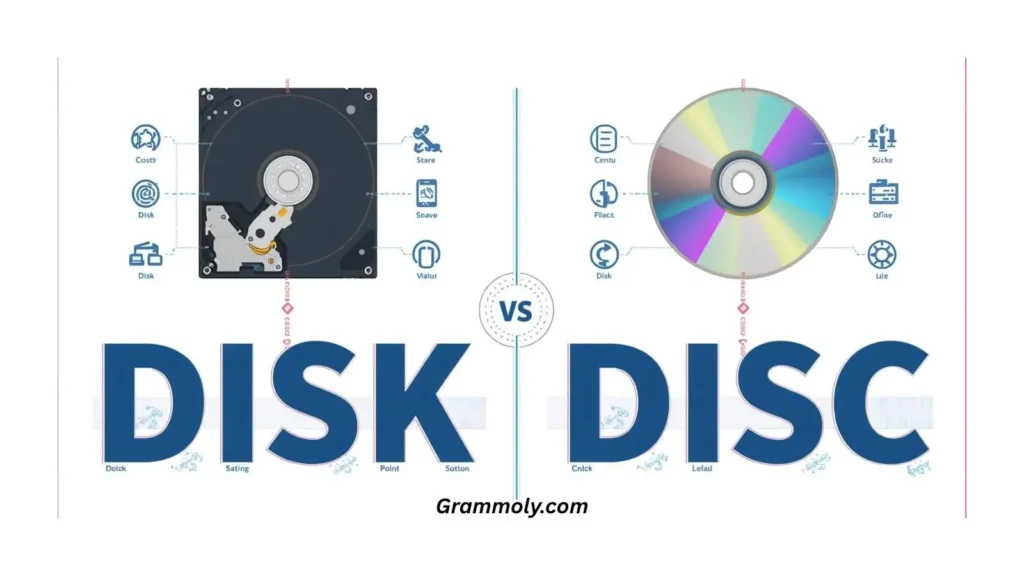
Many writers wonder whether disk or disc is the correct spelling. This common spelling difference often creates confusion in English grammar, especially when discussing technology and storage media. While both words refer to a circular object, their usage varies by context and industry standards. Understanding these writing conventions, word usage, and language rules helps improve communication and accuracy.
|See also: Cocoon vs cacoon
Learning the distinction between disk and disc can strengthen professional writing and ensure consistency across technical and everyday content.
What Do Disk and Disc Mean?
At their core, both disk and disc refer to a flat, circular object.
Historically, the word described any round, flat shape. Over time, technology adopted the term for storage devices and media formats.
Examples
- A hard disk stores computer data.
- A compact disc contains music or digital information.
- The technician replaced the damaged disk drive.
- The collection includes hundreds of music discs.
Although the words have similar meanings, modern usage has created important distinctions.
Disk vs Disc: The Main Difference
Today, the primary difference relates to technology and industry conventions.
Disk
The spelling disk is generally associated with computers and magnetic storage devices.
Examples :
- Hard disk
- Disk drive
- Floppy disk
- Disk partition
- Disk storage
Disc
The spelling disc is commonly used for optical media.
Examples:
- Compact disc (CD)
- Digital versatile disc (DVD)
- Blu-ray disc
- Music disc
- Disc player
As a simple rule, computer storage often uses disk, while optical media frequently uses disc.
The Historical Origin of Disk and Disc
The word originates from the Latin term discus, meaning a circular object or throwing plate.
As English evolved, both disk and disc emerged as acceptable spellings. Different industries later adopted one form over the other.
Technology companies played a major role in shaping modern preferences. Computer manufacturers widely adopted disk, while entertainment and media industries preferred disc for CDs and DVDs.
British English vs American English Spelling Differences
Many English spelling differences occur between British and American English.
|RELATED: Deep seated vs deep seeded
Examples :
| British English | American English |
|---|---|
| Colour | Color |
| Favourite | Favorite |
| Centre | Center |
| Organise | Organize |
| Realise | Realize |
However, disk and disc do not follow the same pattern exactly.
Both British and American English use disc for optical media and disk for computer-related storage in many technical contexts.
Therefore, the distinction is more about industry standards than regional spelling rules.
Understanding the -ise vs -ize Rule
When discussing spelling variations, the famous -ise vs -ize rule often appears.
Many writers believe that -ize is exclusively American and -ise is exclusively British. In reality, the situation is more complex.
Examples
- Organise / Organize
- Realise / Realize
- Recognise / Recognize
- Apologise / Apologize
Both forms are accepted in many English-speaking regions, although style guides may recommend one over the other.
This principle demonstrates how English often contains multiple accepted spellings, much like disk and disc.
How Spell Checkers Influence Spelling Choices
Modern spell checkers significantly affect how people write.
Most spelling software follows language settings selected by the user.
Example:
- US English may favor organize.
- UK English may suggest organise.
- Technical software may recommend disk when discussing computer storage.
As a result, writers sometimes believe one spelling is incorrect when it is simply a regional or contextual preference.
Before accepting spelling suggestions automatically, consider your audience and the context of your writing.
Why Choosing the Correct Spelling Matters
Correct spelling helps establish professionalism and trust.
Readers notice consistency. If a document alternates between disk and disc without reason, it may appear careless or confusing.
Professional Benefits
Using the appropriate spelling can:
- Improve clarity
- Enhance credibility
- Demonstrate attention to detail
- Meet industry expectations
- Strengthen professional communication
Example:
A technology manual discussing hard drives should generally use disk, while a music review discussing CDs should typically use disc.
The correct choice helps readers understand exactly what you mean.
Common Mistakes Writers Make
Using Disc for Hard Drives
Incorrect:
- The computer’s hard disc failed.
Preferred:
- The computer’s hard disk failed.
Using Disk for CDs and DVDs
Less Common:
- Compact disk
Preferred:
- Compact disc
Mixing Spellings Without Purpose
Consistency is important. Choose the spelling that matches the context and maintain it throughout your document.
Practical Usage Guide
Use disk when referring to:
- Hard drives
- Computer storage
- Disk utilities
- Disk management
- Floppy disks
Use disc when referring to:
- CDs
- DVDs
- Blu-ray media
- Music recordings
- Optical storage
Following these conventions helps align your writing with industry standards.
Conclusion
Understanding the difference between disk, disc, computer storage, optical media, and spelling conventions helps writers choose the correct term with confidence. While both spellings are valid, context determines their proper use.
By following industry standards and maintaining consistency, you can improve clarity, strengthen credibility, and communicate more effectively in technical and professional writing.